
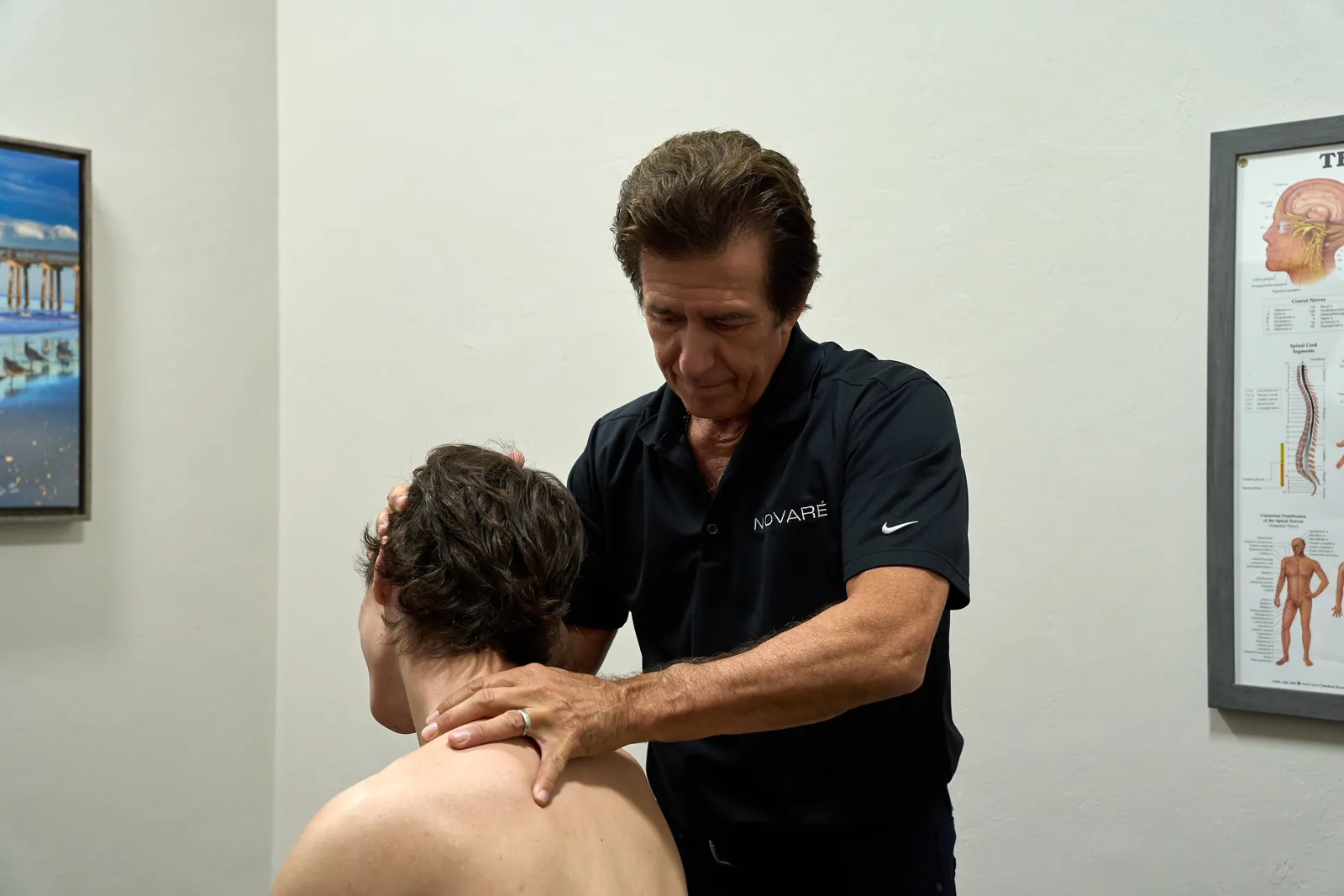
I'm Dr. Ivan Bracic, DC, founder and clinical director of Novaré Injury Care and Rehab in Fort Myers and Lehigh Acres. The most common car accident injuries involve the neck, the back, the head, and the soft tissues that take the force of the seat belt. Many of them barely hurt at the scene.
Below are eight injuries we see after crashes in Southwest Florida, how each one is usually treated, and the signs that mean you need an emergency room first. If you were just in a crash, our accident care page explains how a same-day evaluation works.
If anyone is seriously hurt, call 911 first. Everything in this article comes after that.
What are the most common car accident injuries?
Crash injuries most often affect the neck, back, head, and soft tissues. Cleveland Clinic says whiplash is most common in car crashes, especially rear-end collisions. Get checked even when the damage to your car looks minor.
Timing is part of the problem. Cleveland Clinic notes some whiplash symptoms take at least 12 hours to appear, and all of them can take a few days to show up. Our guide to delayed injuries after a car accident covers that lag in more detail.
1. Whiplash and neck strain
Whiplash happens when sudden force or movement strains the neck and spine. Cleveland Clinic lists neck stiffness and tenderness, pain spreading to the head or shoulders, muscle spasms, and headaches among its symptoms. It also notes most cases are minor and get better within a couple of weeks.
Care usually starts with an exam and x-rays to rule out a fracture. From there, a plan may include manual therapy, gentle adjustments when they're appropriate, and guided exercise. Our article on how long whiplash lasts walks through a typical recovery.
2. Concussion and head injuries
Cleveland Clinic lists motor vehicle accidents among the causes of concussion. Symptoms may start right away, or not for hours or even days. Headache, dizziness, nausea, and blurred vision after a crash are reasons to get checked.
A suspected concussion needs a medical evaluation first. Cleveland Clinic notes most people need at least a few days of little or no activity, guided by their provider. Neck care can come later, once a head injury has been ruled out or is being managed.
3. Headaches after the crash
Headaches are one of the listed symptoms of whiplash. They can come from strained neck muscles and joints, or from a head injury, and the difference changes the plan. Our article on headaches after a car accident explains the common types and the red flags that need urgent care.
4. Low back injuries and herniated discs
The low back absorbs a lot of force in a collision. The American Academy of Orthopaedic Surgeons (AAOS) notes that a traumatic event such as a fall can cause a herniated disk. It adds that most people feel better within a few weeks or months without surgery.
Initial treatment is usually nonsurgical, per AAOS. At Novaré, that may mean manual therapy, Cox flexion-distraction, and rehab exercise, with an MRI before spinal decompression is considered. Our guide to lower back pain after a car accident goes deeper.
5. Pinched nerves and radiating pain
A crash can irritate or compress a nerve, which may send pain, numbness, or tingling into an arm or leg. NINDS lists car accidents among the trauma that can damage nerves, and notes slipped disks can compress nerve fibers near the spinal cord. Report any tingling or numbness, even when it comes and goes.
Treatment depends on where the nerve is being pinched, which is why imaging comes first. New or worsening weakness in an arm or leg is a reason for urgent care, not a wait-and-see approach.
6. Shoulder injuries
The shoulder can be strained by bracing for impact or by the jolt of the collision itself. AAOS notes that a rotator cuff tear that happens suddenly usually causes intense pain. There may also be a snapping sensation and immediate weakness in the upper arm.
Milder strains often respond to manual therapy and rehab exercise. Weakness when lifting the arm, or pain that isn't easing, calls for imaging and sometimes an orthopedic referral.
7. Knee injuries from the dashboard
Knees can strike the dashboard in a frontal crash. AAOS says a common cause of posterior cruciate ligament injuries is a bent knee hitting a dashboard in a car accident. Mention any knee pain or swelling at your exam, even if your neck hurts more.
AAOS describes a careful rehab program once swelling goes down, with exercises to restore function and strengthen the leg. Some ligament injuries need an orthopedic surgeon, so the exam decides who leads that care.
8. Bruises and sprains from the seat belt
The seat belt that protects you can also bruise the chest and hips. Cleveland Clinic calls motor vehicle crashes the top cause of blunt force trauma worldwide. Those injuries range from a minor bruise to broken bones and internal injuries.
Most sprains and bruises ease with time, gentle movement, and soft tissue care. Pain that feels much worse than the visible bruise is a warning sign, though, and belongs in an emergency room.
When is a car accident injury an emergency?
Some injuries need 911 or an emergency room before any clinic visit. Cleveland Clinic lists loss of consciousness, trouble breathing, coughing or vomiting blood, and pink urine as reasons to get emergency care. Go right away if any of these appear:
- A severe headache that keeps getting worse, repeated vomiting, or seizures
- Slurred speech, severe confusion, or trouble walking
- Numbness, weakness, or tingling in the arms or legs
- A bone that looks broken, or severe pain out of proportion to the injury
- Being pregnant and involved in a motor vehicle crash
How does Florida's 14-day rule affect your care?
Florida's PIP law ties medical benefits to getting initial care within 14 days of the crash. Florida Statute 627.736 sets that deadline and a $10,000 limit. Book your evaluation inside that window, even if you feel mostly fine.
Access to the full $10,000 depends on an emergency medical condition (EMC) determination by a medical or osteopathic physician, dentist, physician assistant, or advanced practice registered nurse. A chiropractor can't make this finding. Without one, the medical benefit may be limited to $2,500. Our guide to the Florida 14-day rule explains both gates, and claim questions belong with your insurer or a licensed attorney.
The questions people ask most about car accident injuries, answered in plain language.
Hurting after a crash and not sure what is injured?
You don't have to guess. An exam and digital x-rays on your first visit show what is going on, and we coordinate an MRI or a specialist when it's warranted. Reach us through our contact page or call our Fort Myers office at (239) 893-2225.
This article was written and reviewed by Dr. Ivan Bracic, DC, founder and clinical director of Novaré Injury Care and Rehab in Fort Myers and Lehigh Acres, Florida. Trauma Team certified and a Certified Independent Chiropractic Examiner, Dr. Bracic brings more than 30 years of clinical experience across a career spanning Illinois and Florida. He has served Southwest Florida since founding Novaré in 2019.
Frequently Asked Questions
Can car accident injuries show up days later?
Yes. Cleveland Clinic notes that some whiplash symptoms take at least 12 hours to appear, and that it can take a full day or a few days for all of them to show up. Concussion symptoms can also be delayed by hours or days. That lag is why an exam soon after the crash is worth booking even if you feel mostly fine.
Should I see a doctor after a minor car accident?
It's a good idea. Minor damage to the car doesn't rule out a neck, back, or head injury, and some symptoms start late. In Florida, PIP medical benefits also depend on getting initial care within 14 days of the crash. If you have warning signs such as a worsening headache, trouble breathing, or new weakness, go to the emergency room first.
Can I see a chiropractor after a car accident in Florida?
Florida's PIP law lists licensed chiropractic physicians among the providers who can give initial care, as long as that care starts within 14 days of the crash. Access to the full $10,000 medical benefit depends on an emergency medical condition finding made by an MD, DO, dentist, physician assistant, or APRN, and without one the benefit may be limited to $2,500. Your insurer decides what is paid on your claim, and a licensed attorney can answer legal questions.
When should I go to the ER instead of an accident clinic?
Call 911 or go to the emergency room for loss of consciousness, a severe headache that keeps getting worse, repeated vomiting, seizures, slurred speech, or numbness or weakness in the arms or legs. Trouble breathing, coughing or vomiting blood, pink urine, a bone that looks broken, or being pregnant during a crash also need emergency care. Clinic care comes after those are ruled out.
This article is educational and is not medical or legal advice. It does not diagnose any injury or promise a specific result. If anyone is seriously hurt after a crash, call 911. Go to the emergency room for loss of consciousness, a headache that keeps getting worse, trouble breathing, new numbness or weakness, or severe pain. Questions about your insurance claim belong with your insurer or a licensed attorney.