

The Florida 14-day rule means that to keep your Personal Injury Protection (PIP) medical benefits after a car accident, you generally must be seen by a qualified provider within 14 days of the crash. Miss that window and you can lose your PIP medical coverage entirely, even when your injuries are real. If you have been hurt in a crash in Southwest Florida, our team provides same-day auto accident care in Fort Myers and Lehigh Acres so you can meet the deadline and get the documentation your PIP claim needs.
Of all the rules that govern a Florida car accident, this is the one that catches good people off guard. They feel fine at the scene, they wait to see whether the soreness passes, and by the time real pain sets in, part of their window is already gone. Understanding how the 14-day rule works, and why it exists, is the difference between keeping your coverage and losing it. Here is the deadline explained in plain language.
What exactly is the Florida 14-day rule?
Florida is a no-fault state, which means your own PIP coverage pays first for crash-related medical care regardless of who caused the accident. That coverage comes with a condition written into state law: you generally must receive initial services and care from a qualified provider within 14 days of the accident to remain eligible for PIP medical benefits.
The rule exists to tie medical treatment to the crash itself. By requiring prompt care, the law aims to reduce fraud and stale claims and to make sure injuries are documented while the connection to the accident is still clear. The trade-off is that the deadline is unforgiving. It does not bend for a busy work week, a holiday, or a patient who assumed mild soreness would fade on its own.
When does the 14-day clock start, exactly?
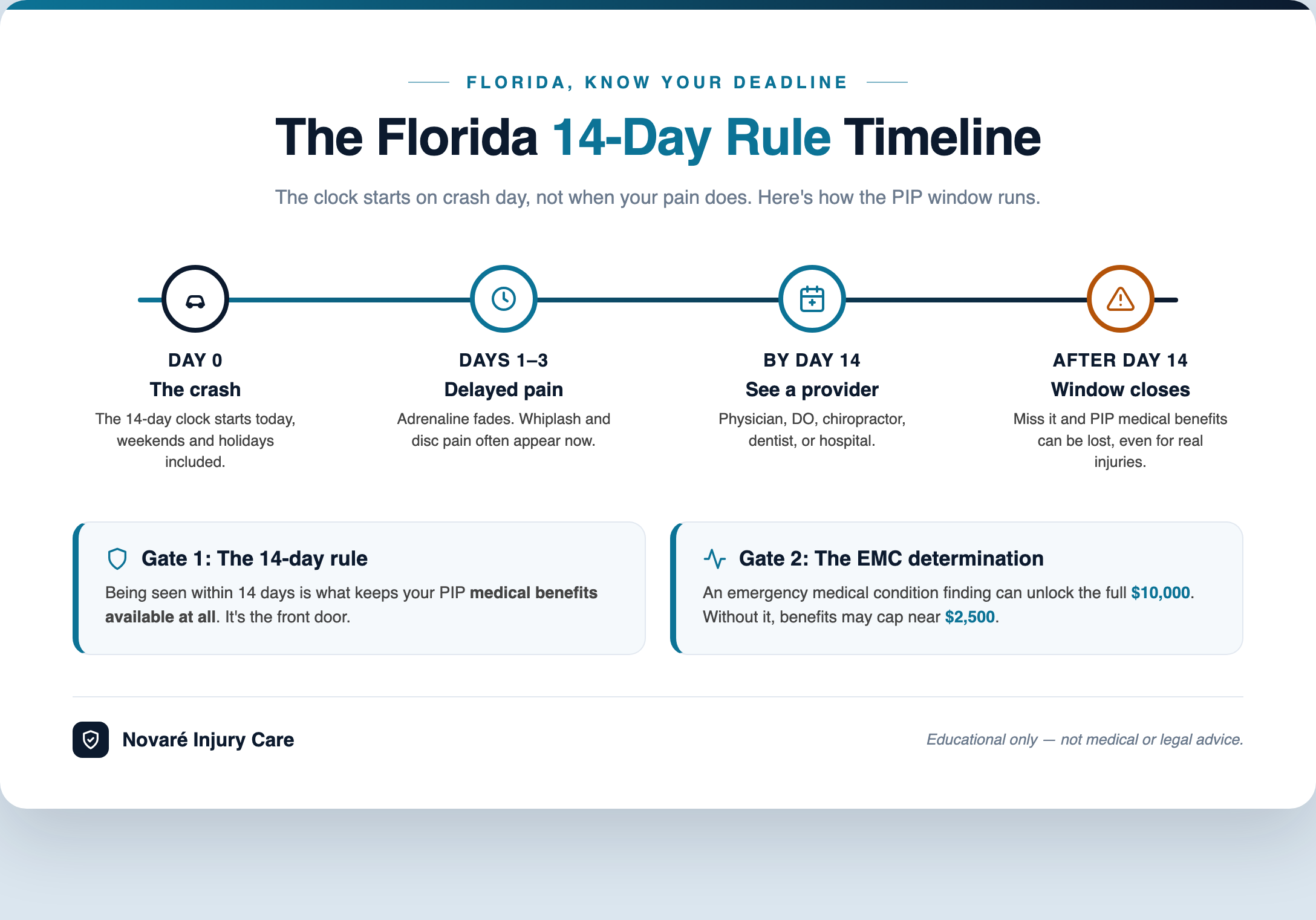
The clock starts on the date of the accident. Not the date your neck stiffens up, not the date the headaches begin, but the day of the crash itself. All 14 calendar days count, including weekends and holidays, so a Friday-evening collision does not buy you extra time.
This is where delayed symptoms become a real trap. Adrenaline masks pain in the hours after a collision, and injuries like whiplash, soft-tissue strains, and disc problems commonly surface a day or several days later. Someone who feels "basically okay" on day one and decides to wait can find that by the time they hurt on day ten, they have burned most of their window on a wait-and-see approach. The safest move is to be evaluated in the first days after any crash, not the second week. The timeline below shows how the clock runs and where the key decisions fall.
Who counts as a qualified provider?
Not every kind of care satisfies the requirement. Under Florida law, qualified providers generally include:
- Physicians (MD or DO)
- Chiropractors (DC)
- Dentists
- Hospitals and certain other facilities
Initial services from one of these providers within the 14 days generally preserve your PIP eligibility. Standalone services like massage therapy or acupuncture do not satisfy the requirement on their own, so your first visit should be with a qualifying medical or chiropractic provider. As a licensed medical corporation, our clinics evaluate crash patients within the window and coordinate any further imaging or specialty care from there. A first visit typically includes a thorough exam, in-house digital X-ray, and a clear report of findings, so you leave understanding what is injured and what the plan is.
What happens if you miss the 14-day deadline?
If more than 14 days pass before you receive initial care, you can lose access to your PIP medical benefits, even when your injuries are genuine and crash-related. That is a hard outcome, and it is exactly why we and most Florida injury clinics urge crash patients not to wait.
Missing the window does not mean you are out of options, and it absolutely does not mean you should skip care. Your health comes first, so get evaluated regardless of the date. Other coverage may still apply, such as your health insurance, other available policies, or a claim against an at-fault driver. Because these situations get technical fast, this is a moment to speak with a licensed attorney about your specific circumstances. The one thing not to do is assume it is too late and go untreated.
How the 14-day rule connects to the $10,000 PIP limit
People often blur two separate rules together, so it helps to keep them distinct. Meeting the 14-day deadline is what keeps your PIP medical benefits available at all. It is the gate at the front door.
Access to the full $10,000 PIP minimum is a second, separate question. It can depend on whether a qualified provider determines that you have an emergency medical condition (EMC). With an EMC determination, your PIP medical benefit can reach the full $10,000. Without one, your benefit may be capped at a lower amount, often $2,500. A qualified provider evaluates whether your injury meets the EMC standard and documents it as part of your care.
So the two gates work in sequence: the 14-day rule decides whether you have PIP medical benefits, and the EMC determination influences how much of the $10,000 you can access. Beyond the medical side, PIP generally pays 80% of reasonable and necessary medical bills and 60% of lost wages up to the limit, which is why keeping careful records from day one matters. If your injuries call for ongoing treatment, coordinated whiplash treatment, chiropractic and manual therapy, and spinal decompression for disc injuries are matched against whatever coverage applies at each stage.
Why prompt care protects more than your coverage
Beating the 14-day deadline is not only about paperwork. Being seen early is better medicine. Whiplash and disc injuries often worsen over the first week rather than the first hour, and starting care before compensation patterns set in tends to make recovery more straightforward. Early imaging and an exam also create a clean record that links your injuries to the crash, which matters clinically and, if it ever comes up, legally.
That is the throughline: the sooner you are evaluated, the more your provider can help, the stronger your documentation, and the safer your PIP coverage. Waiting only works against you on every one of those fronts.
A note on scope: this article explains how Florida's 14-day rule generally works. It is educational, not medical or legal advice. For your specific injuries and your specific policy, rely on a qualified provider and a licensed attorney.
The questions we hear most from Florida crash patients, answered in plain language.
Beat the clock: start your accident care today
The 14-day rule is unforgiving, but meeting it is simple: get evaluated promptly. If you have been in a car accident in Southwest Florida, our auto accident care team in Fort Myers and Lehigh Acres offers same-day and next-day appointments, in-house imaging, and the documentation your PIP claim needs. Call our Fort Myers office at (239) 893-2225 to get seen within your window and protect both your recovery and your coverage.
This article was reviewed by Dr. Ivan Bracic, DC, founder and clinical director of Novaré Injury Care and Rehab in Fort Myers and Lehigh Acres, Florida. Trauma Team certified and a Certified Independent Chiropractic Examiner, Dr. Bracic has spent more than 30 years caring for injury patients and documenting crash-related cases.
Frequently asked questions
What is the Florida 14-day rule?
The Florida 14-day rule is a deadline in the state's no-fault law. To be eligible for Personal Injury Protection (PIP) medical benefits, you generally must receive initial care from a qualified provider within 14 days of a car accident. If you wait longer than 14 days to begin care, you can lose access to your PIP medical benefits, even if your injuries are real and clearly caused by the crash.
When does the 14-day clock start?
The clock starts on the date of the accident, not the date your symptoms appear or worsen. All 14 calendar days count, including weekends and holidays. Because the deadline runs from the crash itself, waiting to 'see how you feel' is risky, since pain from whiplash or disc injuries often shows up days later, when part of your window has already passed.
Who counts as a qualified provider for the 14-day rule?
Under Florida law, qualified providers generally include physicians (MD or DO), chiropractors, dentists, and hospitals, among certain others. Initial services from one of these providers within 14 days generally preserve your PIP eligibility. Massage and acupuncture alone do not satisfy the requirement, so your first visit should be with a qualifying medical or chiropractic provider.
What happens if I miss the 14-day deadline?
If more than 14 days pass before you receive initial care, you can lose access to your PIP medical benefits, even when your injuries are genuine. You should still get evaluated for your health, and other coverage may apply, such as health insurance or a claim against an at-fault driver. Do not skip care because you think it is too late, and speak with a licensed attorney about your options.
How does the 14-day rule relate to the $10,000 PIP limit?
Meeting the 14-day deadline is what keeps your PIP medical benefits available at all. Separately, access to the full $10,000 minimum can depend on whether a qualified provider determines you have an emergency medical condition (EMC). Without an EMC determination, your PIP medical benefit may be capped at a lower amount, often $2,500. The 14-day rule and the EMC determination are two different gates, and both matter.