
Lower back pain after a car accident usually traces to one of four things: the facet joints along the back of your spine, the discs that cushion the vertebrae, the muscles and ligaments that stabilize your low back, or the sacroiliac joint where your spine meets your pelvis. Which one it is decides how it's treated. If you're dealing with back pain after a crash in Southwest Florida, our team offers non-surgical low back pain treatment in Fort Myers and Lehigh Acres and documents the connection between your symptoms and the accident. The Cleveland Clinic notes that most low back pain does not require surgery.
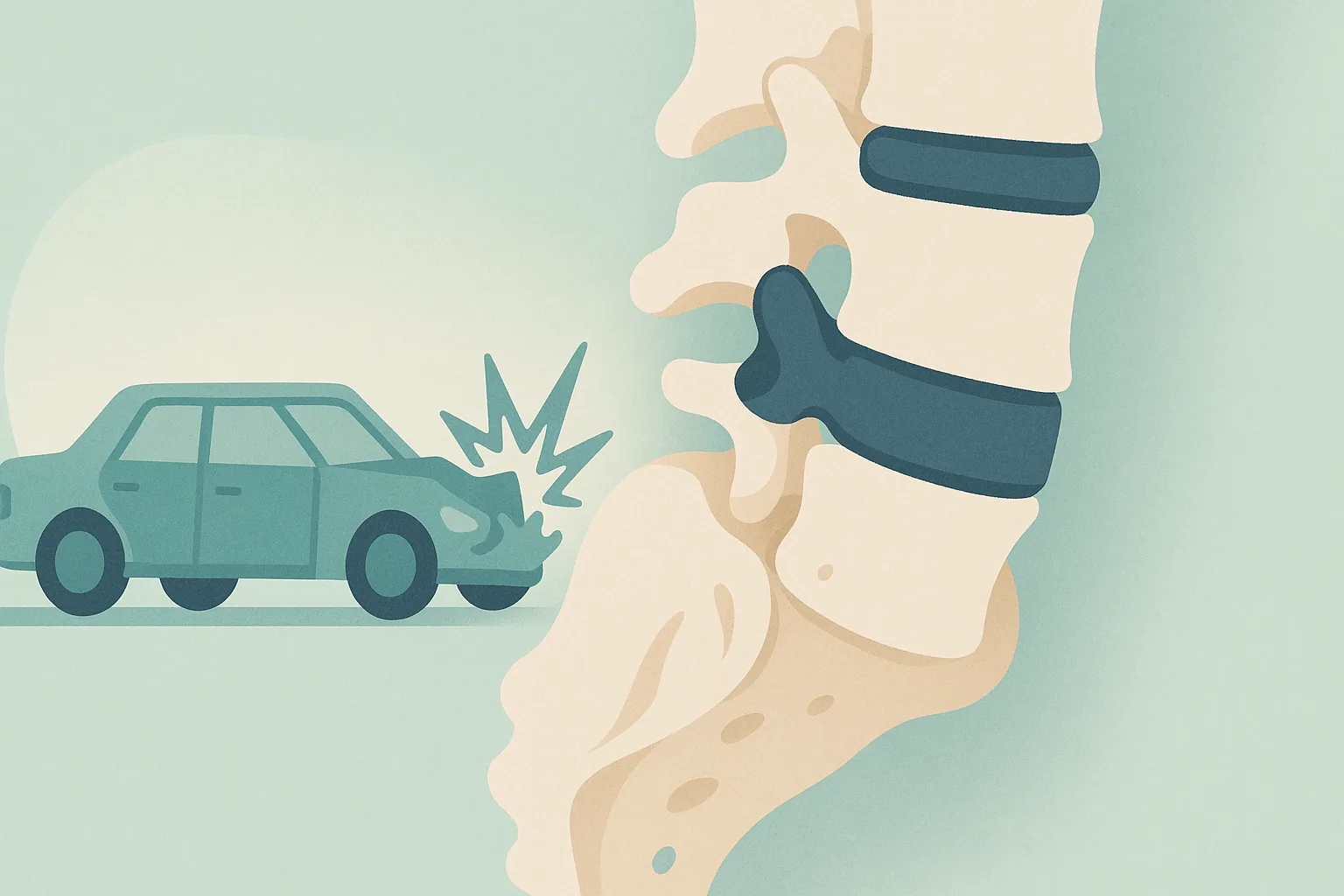
I'm Dr. Ivan Bracic, and I've spent more than 30 years treating injury patients, a lot of them right here in Fort Myers and Lehigh Acres. Low back pain is one of the most common complaints I see after a crash, and the question underneath it is almost always the same: what did I actually hurt, and is it going to get better? Here's a straight answer to both.
What causes lower back pain after a car accident
Crash-related low back pain comes from the low back absorbing forces it was never built for. A rear-end or T-bone impact throws your pelvis and spine in a direction they didn't brace for, and the structures that hold you upright take the hit.
The reason the cause matters so much is that the fix isn't the same for each one. A ligament strain, a jammed joint, and a bulging disc all hurt in the low back, but they need different care. That's why I start with an exam and, when it's warranted, imaging, rather than guessing from the outside. Below are the four injuries I see most.
Facet joint injuries
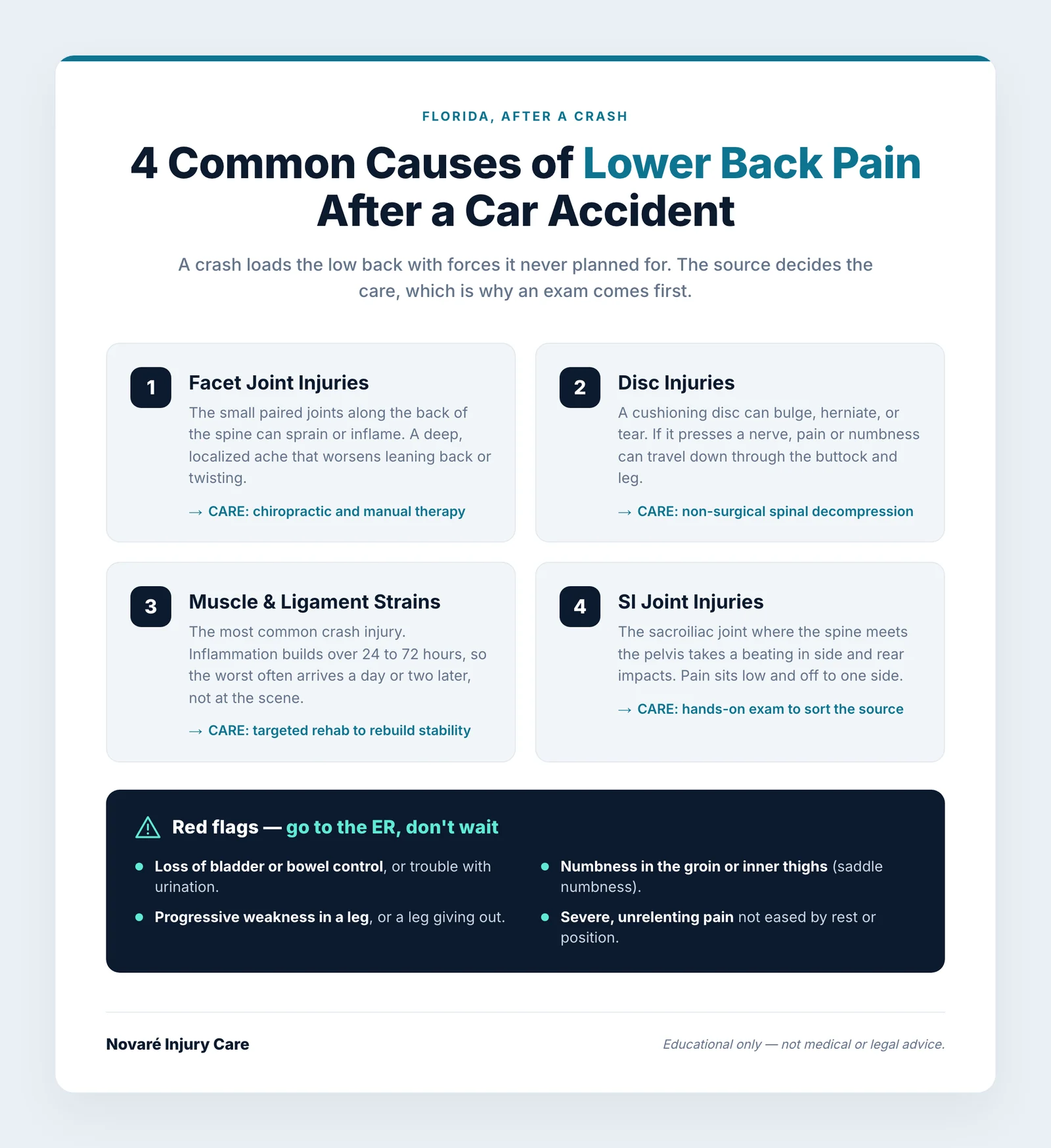
The facet joints are the small paired joints running down the back of your spine that let you bend and twist. In a collision, the sudden compression and rebound can sprain or inflame them, the same way you'd sprain an ankle.
Facet pain tends to be a deep, localized ache close to the spine that gets worse when you lean back or twist and eases a little when you sit or bend forward. It often doesn't shoot down the leg the way a nerve problem does. A lot of the "my back locks up when I stand" complaints I hear after a crash trace back to irritated facet joints.
Disc injuries
Between each pair of vertebrae sits a disc that works like a cushion. Crash forces can bulge, herniate, or tear a disc in the low back, and if that disc presses on a nearby nerve root, the pain doesn't stay put.
This is where you get symptoms that travel: pain, tingling, numbness, or weakness running down through the buttock and into the leg. If that sounds like sciatica, it can be. A herniated or bulging disc pressing on the nerve is one of the most common crash causes of it, and it's a big reason we look closely at the discs on imaging. I've had patients arrive certain it was "just a pulled muscle" whose MRI showed disc herniations driving the whole picture.
Muscle and ligament strains
The most common crash injury is also the one people underrate. The muscles and ligaments that stabilize your low back get overstretched in a collision, and they respond with spasm, stiffness, and inflammation.
Here's the catch with strains: the inflammation builds over the first 24 to 72 hours, so the worst of it often arrives a day or two after the crash, not at the scene. People feel manageable Saturday and can barely move by Monday. That delay leads folks to assume the injury is minor or unrelated to the accident. Neither is usually true. A strain that gets ignored can settle into the kind of daily back pain that lingers for months.
SI joint injuries
The sacroiliac joint connects your lower spine to your pelvis, and it takes a real beating in side-impact and rear-end crashes. When it gets jarred out of its normal motion, it produces pain low and off to one side, often around the top of the buttock, and it can mimic both disc pain and hip pain.
SI joint pain usually feels worse when you stand up from sitting, climb stairs, or roll over in bed. It's easy to miss because it borrows symptoms from its neighbors, which is exactly why a hands-on exam matters. Sorting the SI joint from a disc from a facet is a big part of what the first visit is for.
When lower back pain after a crash is urgent
Most low back pain after a car accident is not an emergency, but a few symptoms are, and you should not wait on them. If any of these show up, treat it as urgent and go to the emergency room, not a chiropractor's office.
- Loss of bladder or bowel control, or trouble starting or stopping urination.
- Numbness in the groin, buttocks, or inner thighs, sometimes called saddle numbness.
- Progressive weakness in one or both legs, or a leg that's giving out.
- Severe, unrelenting pain that isn't eased at all by rest or position changes.
These can point to serious nerve compression that needs immediate evaluation. They're rare, but they matter, so I'd rather you know them and never need them. If you're not sure, err toward getting checked right away.
How lower back pain after a car accident is treated
The honest answer is that it depends on what's injured, which is why the exam comes before the plan. At Novaré Injury Care & Rehab, an evaluation usually starts with a hands-on exam and, when it's warranted, first-visit diagnostic imaging so we're treating what's actually there instead of guessing. I read the imaging myself before I recommend anything.
From there, care for most crash-related low back injuries is non-surgical. Depending on the source, a plan might include chiropractic and manual therapy for facet and soft-tissue injuries, non-surgical spinal decompression for disc-related pain, and targeted rehab to rebuild the muscles that stabilize your low back. If the pain is traveling down your leg, our sciatica treatment addresses the nerve involvement directly.
If your pain is coming from an irritated nerve rather than a joint or muscle, that's its own topic. I've written a separate guide on a pinched nerve in the lower back that walks through the nerve-specific symptoms and care, and it's a good companion to this one. A lot of people who searched for crash-related back pain really have a nerve question underneath it.
Why early care protects your recovery and your coverage
Getting evaluated early does two jobs at once. Clinically, it catches the injury while treatment is most straightforward and keeps a treatable strain from becoming chronic pain. On the coverage side, it creates a medical record connecting your symptoms to the crash from the start.
In Florida, that timing runs into a deadline. To keep your PIP medical benefits, you generally have to be seen by a qualified provider within 14 days of the accident. Because low back pain often surfaces late, it's easy to wait past that window while you decide whether it's "bad enough." I've explained how that clock works in 7 things to do after a car accident in Florida, and it's worth reading before you decide to wait it out.
A gap between the crash and your first visit is one of the first things an insurer looks for. Getting checked early closes that gap and protects both your back and your claim.
A note on scope: this article explains what generally happens after a Florida crash. It is educational, not medical or legal advice. For your specific injuries and your specific policy, rely on a qualified provider and a licensed attorney.
The questions I hear most from patients with low back pain after a crash, answered plainly.
Hurt your back in a crash? Get it evaluated before the window closes
You don't have to be certain something's wrong to get checked, and you shouldn't let the 14-day clock run out while you wait to see how your back feels. If lower back pain has shown up after a crash in Southwest Florida, our non-surgical low back pain treatment in Fort Myers and Lehigh Acres starts with an exam and in-house imaging, and we handle the documentation your PIP claim needs. Call our Fort Myers office at (239) 893-2225 to get seen quickly.
This article was reviewed by Dr. Ivan Bracic, DC, founder and clinical director of Novaré Injury Care and Rehab in Fort Myers and Lehigh Acres, Florida. Trauma Team certified and a Certified Independent Chiropractic Examiner, Dr. Bracic has spent more than 30 years caring for injury patients and documenting crash-related low back injuries.
Frequently asked questions
What causes lower back pain after a car accident?
Most crash-related low back pain comes from one of four structures: the facet joints along the back of the spine, the discs between the vertebrae, the muscles and ligaments that hold the spine steady, or the sacroiliac (SI) joint where the spine meets the pelvis. A rear-end or side impact loads the low back with forces it never planned for, and any of these can strain, tear, or shift. The exact source matters because the treatment for a facet sprain is different from the treatment for a bulging disc, which is why an exam and, when warranted, imaging come first.
How long does lower back pain last after a car accident?
It depends on what's injured. A simple muscle or ligament strain often settles over a few weeks with the right care, while a disc injury or an aggravated joint can take longer and sometimes needs active treatment to keep it from becoming chronic. What I tell patients is this: the pain that's still there at three or four weeks, or that's getting worse instead of better, is the pain worth taking seriously. Early evaluation tends to make recovery more straightforward than waiting to see if it fades on its own.
Is lower back pain after a crash serious?
It can be, and delayed or mild pain doesn't rule it out. Adrenaline masks pain at the scene, and disc and soft-tissue injuries often surface a day or two later. Most low back pain after a crash is treatable without surgery, but some symptoms need urgent care, including loss of bladder or bowel control, numbness in the groin or inner thighs, or progressive weakness in a leg. If any of those show up, treat it as an emergency and go to the ER.
Should I see a doctor for lower back pain if I feel okay after the accident?
Yes. Feeling fine at the scene is common, because adrenaline turns down pain and disc and soft-tissue injuries build over the following days. A prompt evaluation catches a hidden injury before it worsens and creates a medical record linking your symptoms to the crash. In Florida, it also protects your Personal Injury Protection (PIP) medical benefits, which generally require you to be seen by a qualified provider within 14 days of the accident.
Can chiropractic care help lower back pain from a car accident?
For many crash-related low back injuries, yes. Chiropractic and manual therapy, targeted rehab, and non-surgical spinal decompression are common approaches for facet, disc, and soft-tissue injuries once an exam has ruled out anything that needs urgent or surgical care. The right plan depends on what the exam and any imaging find, which is why I read the imaging myself before recommending a course of treatment rather than starting with a one-size-fits-all adjustment.