
I'm Dr. Ivan Bracic, and I've spent more than 30 years caring for injury patients, a lot of them here in Fort Myers and Lehigh Acres. The question I hear most from people right after a crash isn't about their neck. It's "how does PIP insurance work, and will it actually pay for this?" Florida is a no-fault state, so your own Personal Injury Protection (PIP) coverage generally pays first for crash-related care no matter who caused the accident. If you were hurt in a crash in Southwest Florida, our team provides same-day auto accident care in Fort Myers and Lehigh Acres and handles the PIP paperwork so you can focus on getting better.
PIP confuses almost everyone, and I don't blame anyone for that. The rules are specific, the numbers have conditions attached, and you're trying to understand all of it while you're in pain. So here are the five things that actually decide what your PIP covers, in plain language. Know these, and the rest of the process gets a lot less frightening.
1. PIP pays first because Florida is a no-fault state
The short version: your own auto policy pays your initial crash-related medical bills regardless of who caused the accident. That's what "no-fault" means. You don't wait to prove the other driver was to blame before you get care.
Every Florida auto policy is generally required to carry PIP, so if your vehicle is registered here, you almost certainly have it. When you're hurt, you turn to your own insurer first and open a PIP claim, even when the other driver clearly ran the light.
Fault doesn't disappear, though. It can still matter for a separate claim against the at-fault driver for injuries and losses that go beyond what PIP covers. PIP is just designed to get money moving for your care quickly, before anyone sorts out blame. For anything involving fault or a claim against another driver, that's a question for a licensed attorney, not for me.
2. The 14-day rule decides whether PIP covers you at all
This is the one that costs people their benefits, so I put it near the top. To be eligible for PIP medical benefits, Florida law generally requires that you receive initial care from a qualified provider, such as a physician, chiropractor, dentist, or hospital, within 14 days of the crash.
Wait longer than 14 days, and you can lose access to your PIP medical benefits entirely, even when your injuries are real and clearly came from the accident. The clock doesn't care how busy your week was. It just runs.
Here's what worries me clinically: a lot of people feel okay the day of the crash and decide to "see how it goes." Adrenaline masks pain for hours or even days, and injuries like whiplash, soft-tissue strains, and disc problems often surface later. Getting seen early does two things at once. It catches hidden injuries before they worsen, and it protects your eligibility inside that 14-day window. If you're anywhere near that deadline, get evaluated now.
3. PIP generally pays about 80% of your medical bills, not all of it
A direct answer first: PIP generally pays about 80% of reasonable and necessary medical expenses, not 100%. It also typically covers 60% of lost wages, up to your policy limit. The remaining share of your bills doesn't just vanish.
People are often surprised by that 80% figure. They assume "up to $10,000 in coverage" means every dollar of care is paid until they hit $10,000. In practice, PIP pays its percentage of each reasonable and necessary bill, and the rest may be handled through other coverage, a health plan, or a claim against an at-fault driver.
That's exactly why documentation matters so much. Clean, complete records of what was treated and why are what let a PIP claim pay what it's supposed to. When we see accident patients, first-visit diagnostic imaging helps pin down what's actually injured, and that record supports both your recovery and your claim.
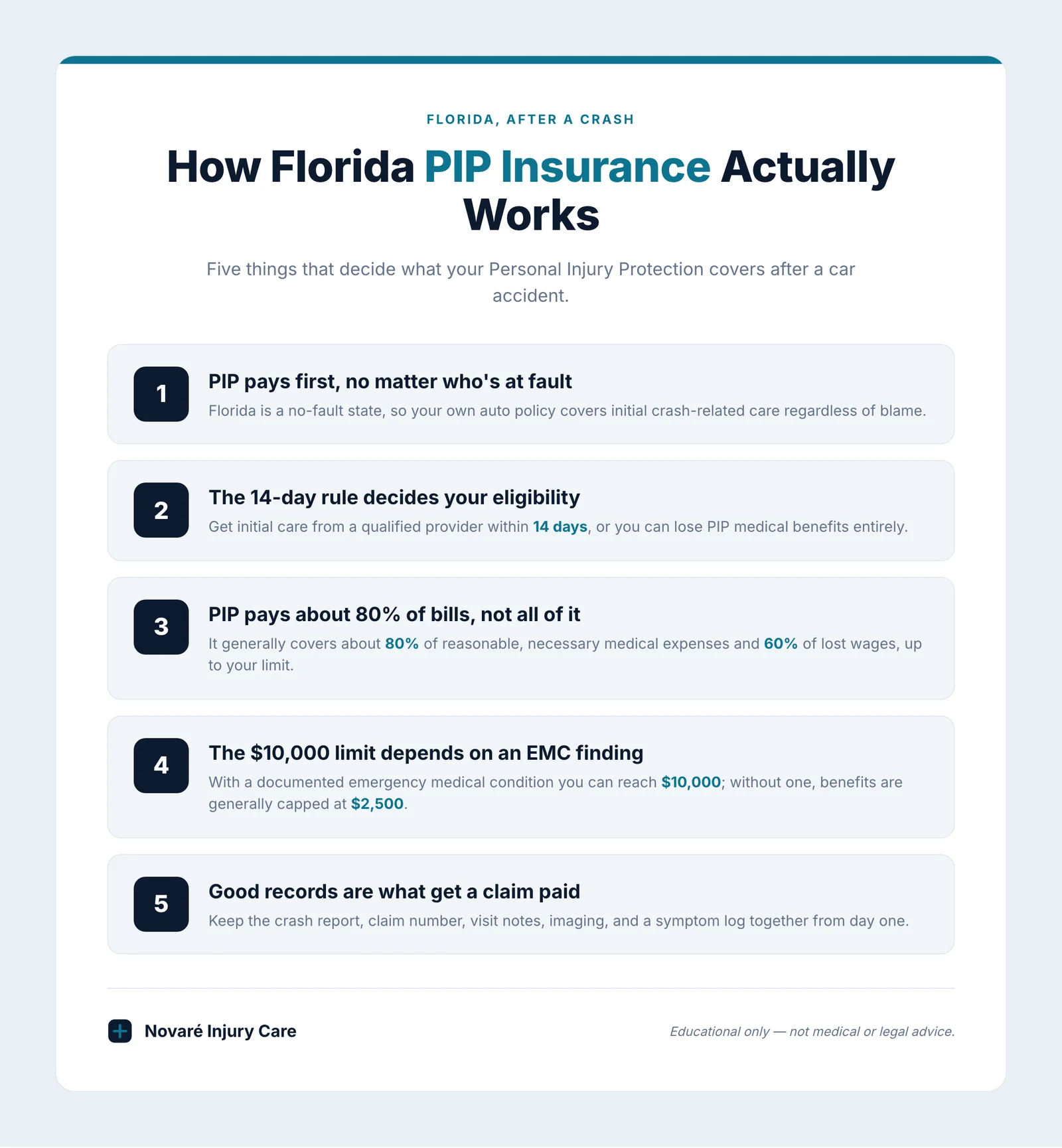
4. The $10,000 limit depends on an emergency medical condition finding
Here's where the number most people quote comes with a big condition attached. Florida PIP generally provides up to $10,000 in benefits, but you can only access the full amount if a qualified physician determines you have an emergency medical condition (EMC).
If a physician documents an EMC, you can generally reach up to that $10,000 limit. Without an EMC determination, your PIP medical benefits are generally capped at $2,500. That's a $7,500 difference resting on a clinical finding, which is one more reason early, thorough evaluation matters.
An EMC isn't a box we check to unlock money. It's a genuine medical determination based on your actual condition, and it has to be documented properly as part of your care. If your injuries warrant it, getting evaluated promptly means that finding can be made and recorded within the window, instead of after benefits are already limited.
5. Good records are what actually get your claim paid
From day one, keep everything related to the crash in one place. That means the crash report number, your insurer's claim number, every provider visit note, imaging, receipts, and a simple log of your symptoms and any missed work. Digital or paper, it doesn't matter, as long as it's together.
I've watched valid claims get slowed down or shortchanged for one reason: gaps and missing paperwork. An unexplained gap between the crash and your first visit is one of the first things an insurer looks for. So is care that isn't clearly documented as connected to the accident.
Good records protect you on both sides. Clinically, a symptom log helps your provider track how you're recovering and adjust treatment. On the coverage side, organized documentation is the foundation a PIP claim is built on. If your injuries need ongoing hands-on care, that's where chiropractic and manual therapy, whiplash treatment, and spinal decompression for disc injuries come in, and each visit adds to the record that supports your claim.
A note on scope: this article explains how Florida PIP generally works. It's educational, not medical or legal advice. For your specific injuries and your specific policy, rely on a qualified provider and a licensed attorney, especially for questions about coverage limits, fault, or a claim against another driver.
The PIP questions we hear most from Florida crash patients, answered in plain language.
Hurt in a crash? Get seen and get your PIP claim started
You don't have to figure PIP out alone, and you shouldn't let the 14-day clock run down while you decide. If you've been in a car accident in Southwest Florida, our auto accident care team in Fort Myers and Lehigh Acres offers same-day and next-day appointments, in-house imaging, and the documentation your PIP claim needs. Call our Fort Myers office at (239) 893-2225 to get seen quickly and protect both your recovery and your coverage.
This article was reviewed by Dr. Ivan Bracic, DC, founder and clinical director of Novaré Injury Care and Rehab in Fort Myers and Lehigh Acres, Florida. Trauma Team certified and a Certified Independent Chiropractic Examiner, Dr. Bracic has spent more than 30 years caring for injury patients and documenting crash-related cases.
Frequently asked questions
How does PIP insurance work in Florida?
Florida is a no-fault state, so your own Personal Injury Protection (PIP) coverage pays first for crash-related medical care no matter who caused the accident. PIP generally covers up to $10,000 and typically pays about 80% of reasonable and necessary medical expenses, plus a portion of lost wages, up to your policy limit. To keep your PIP medical benefits, Florida law generally requires you to be seen by a qualified provider within 14 days of the crash.
How much does Florida PIP insurance cover?
Florida PIP generally provides up to $10,000 in benefits, but access to the full amount depends on an emergency medical condition (EMC) determination. If a qualified physician documents an EMC, you can generally access up to the $10,000 limit. Without an EMC finding, benefits are generally capped at $2,500. PIP typically pays about 80% of reasonable and necessary medical bills and 60% of lost wages, up to the limit.
What is the 14-day rule for PIP in Florida?
Florida law generally requires that you receive initial care from a qualified provider, such as a physician, chiropractor, dentist, or hospital, within 14 days of your accident to be eligible for PIP medical benefits. Miss that window and you can lose access to your PIP medical benefits, even when your injuries are genuine and clearly crash-related. Because of that, prompt evaluation after a crash matters.
Does PIP cover 100% of my medical bills?
Generally no. Florida PIP typically pays about 80% of reasonable and necessary medical expenses, not the full amount, and it stops paying once you reach your policy limit. The remaining balance may be handled through other coverage, a health plan, or a claim against an at-fault driver. Because how the rest is paid depends on your situation, it's worth asking your provider and a licensed attorney.
Do I use PIP even if the other driver caused the accident?
Yes. Under Florida's no-fault system, you generally turn to your own PIP coverage first for initial medical care regardless of who was at fault. Fault can still matter for other claims, such as a claim against the at-fault driver for injuries or losses beyond your PIP limit, but PIP is designed to pay first so you can get care quickly. For questions about pursuing an at-fault driver, talk to a licensed attorney.