
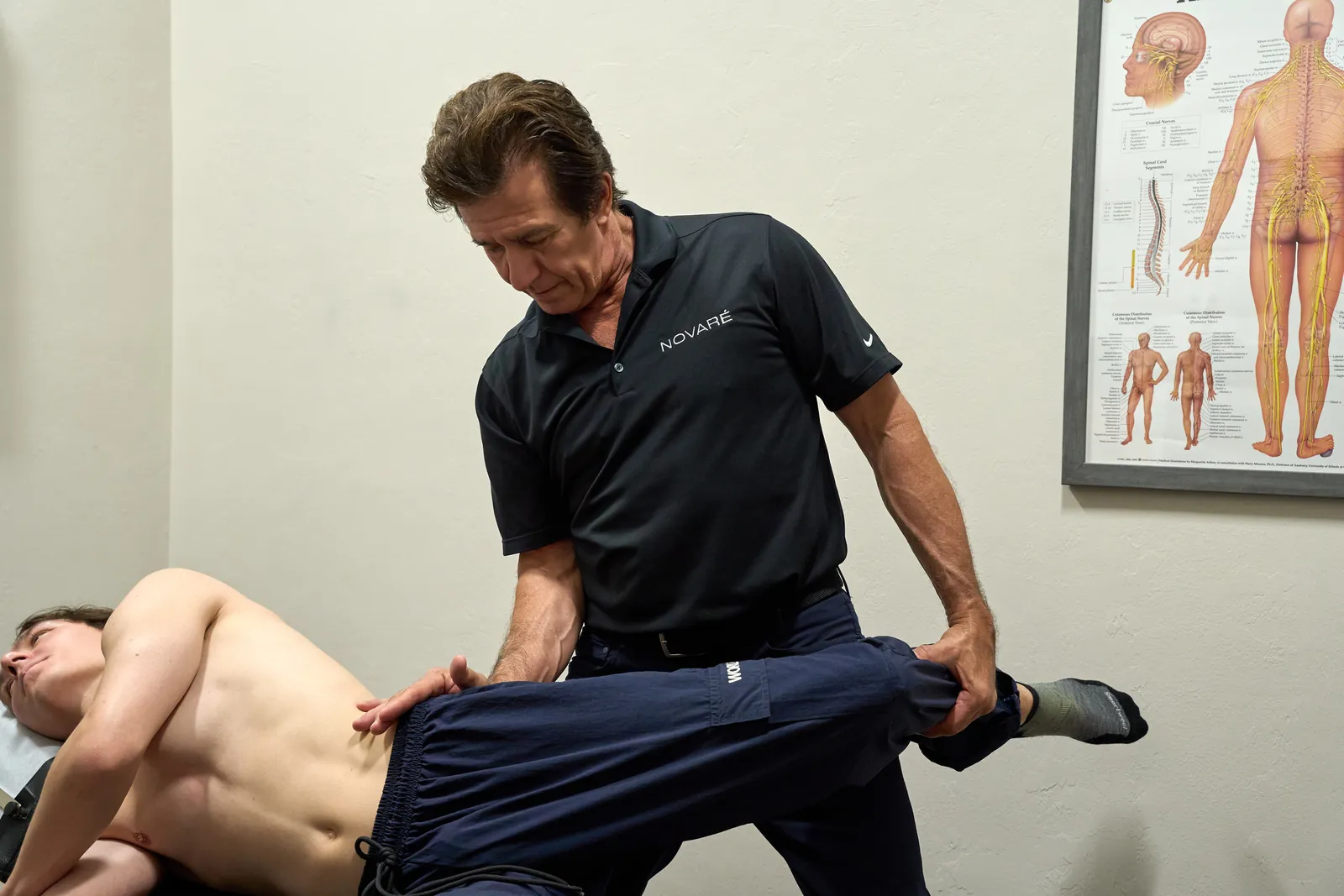
I'm Dr. Ivan Bracic, DC, founder and clinical director of Novaré Injury Care and Rehab in Fort Myers and Lehigh Acres. Gentle stretches for lower back pain may ease stiffness and help you move more comfortably while your back settles down. The three below need no equipment and can be done on the floor or a firm bed.
Go slowly, breathe, and stop if a stretch causes sharp pain or makes your symptoms worse. If your back pain started after a crash or fall, skip the stretches and get examined first.
If your pain keeps coming back, our low back pain treatment page explains how we look for the cause.
Do stretches help lower back pain?
Gentle stretching may ease a stiff, achy lower back for many people. Cleveland Clinic notes that rest can add stiffness and that gentle movement can help, as long as you don't push through increased pain. Use these stretches as one part of staying active.
The NHS says lower back pain is very common and usually improves within a few weeks. It also recommends staying active and avoiding long periods in bed. Stretches won't fix every cause of back pain, which is why pain that lingers deserves an exam.
How to stretch your lower back safely
A few ground rules keep these stretches gentle:
- Move slowly and breathe normally, without bouncing.
- Aim for a light pull, never sharp or shooting pain.
- Stop if pain increases or spreads into your leg.
- Skip any stretch you can't get into or out of comfortably.
- Talk with a provider first if your pain started with a fall, a crash, or an illness.
1. Knee-to-chest stretch
The knee-to-chest stretch may ease tension in the low back and buttock. Cleveland Clinic includes it among its sciatica stretches.
Lie on your back with your knees bent and feet flat. Bring one knee toward your chest and hold behind your thigh or over your shin until you feel a gentle stretch. Hold for a few slow breaths, lower the leg, and switch sides.
If pulling on the shin bothers your knee, hold behind the thigh instead. Keep the other foot on the floor so your low back stays relaxed.
2. Lying trunk rotation
This gentle twist may loosen the muscles along the sides of the low back. Lie on your back with knees bent and together, feet flat. Slowly lower both knees to one side while keeping your shoulders and upper back down.
Cleveland Clinic suggests holding the light stretch for 5 to 10 seconds, then returning to center and switching sides. It recommends 3 to 5 repetitions per side, or whatever feels good.
Dr. Bracic demonstrates a version of this move in our video on a stretch before bed for lower back pain. Keep the movement small at first and let your knees drop only as far as is comfortable.
3. Child's pose
Child's pose gently lengthens the back while your body rests. Start on your hands and knees on the floor or a bed. Bring your big toes together, widen your knees, and sit your hips back toward your heels with your arms reaching forward.
Cleveland Clinic suggests holding the pose for 10 to 30 seconds. If getting down on all fours is hard, it describes a standing version. Place your hands on a counter, step back, and hinge at the hips with a flat back.
Go only as far as your hips and knees allow. Stop if you feel pain travel down a leg.
What else may help between stretches?
Stretching works best alongside everyday movement. The NHS recommends staying active, and suggests an ice pack or heat pack wrapped in a towel for pain, swelling, or stiffness. Avoid long stretches of bed rest.
If you want more options, our guide on how to decompress your spine at home covers other gentle moves and what to skip.
When is back pain a reason to stop stretching and get help?
Some back pain needs a medical evaluation, and some needs emergency care. The NHS says to call 999 or go to A&E for back pain with numbness around the genitals or anus, bladder or bowel changes, or weakness in both legs. In the U.S., call 911 or go to the emergency room for:
- Numbness between the legs, around the genitals or anus, or in the inner thighs
- New trouble controlling or emptying your bladder or bowels
- Weakness, numbness, or tingling in one or both legs
- Back pain that started after a car accident, a fall, or other major trauma
Get same-day medical care for severe pain that starts suddenly, or back pain with a fever or feeling unwell.
AAOS calls cauda equina syndrome a surgical emergency. Book a regular appointment if your pain isn't improving after a few weeks, keeps returning, or limits your daily life.
The questions people ask most about stretches for lower back pain, answered in plain language.
Stretching but your back still won't settle?
That's a sign to look deeper. An exam and digital x-rays on your first visit can show what is behind the pain, and we'll show you which moves fit your back. Reach us through our contact page or call our Fort Myers office at (239) 893-2225.
This article was written and reviewed by Dr. Ivan Bracic, DC, founder and clinical director of Novaré Injury Care and Rehab in Fort Myers and Lehigh Acres, Florida. Trauma Team certified and a Certified Independent Chiropractic Examiner, Dr. Bracic brings more than 30 years of clinical experience across a career spanning Illinois and Florida. He has served Southwest Florida since founding Novaré in 2019.
Frequently Asked Questions
What is the best stretch for lower back pain?
There isn't one best stretch for everyone. Knee-to-chest, lying trunk rotation, and child's pose are gentle options that may ease stiffness for many people. The right choice depends on what is causing your pain, so if a stretch makes your symptoms worse, stop and get evaluated.
How often should I do stretches for lower back pain?
Gentle stretches can usually be done daily if they feel good. A Cleveland Clinic physical therapist says to give yourself a couple of weeks or more before expecting significant changes, so consistency matters. Stop or scale back if pain increases, and get checked if the pain is not easing after a few weeks.
Should I stretch if my back hurts after a car accident?
Not before an exam. Cleveland Clinic advises talking with a healthcare provider before stretching back pain that came from trauma such as a fall or an accident. The NHS says back pain that started after a serious accident, such as a car accident, needs emergency care. An exam and imaging come first to rule out a fracture or disc injury.
When is lower back pain an emergency?
Call 911 or go to the emergency room if back pain comes with numbness between the legs or around the genitals or anus, new trouble controlling or emptying your bladder or bowels, or weakness or numbness in the legs. The same goes for pain after major trauma. These can be signs of a serious problem, such as cauda equina syndrome, that needs urgent care.
This article is educational and is not medical advice. It does not diagnose any condition or promise a specific result. Stop any stretch that causes sharp pain or makes your symptoms worse. Call 911 or go to the emergency room if back pain comes with numbness between the legs or around the genitals or anus, new bladder or bowel changes, weakness or numbness in the legs, or if it started after a car accident, fall, or other major trauma.