
If you have been in a car accident in Florida, the first things to do are get to safety, call 911, and see a qualified provider promptly, because your health and your Personal Injury Protection (PIP) benefits both depend on acting quickly. Florida's no-fault system generally gives you 14 days to be seen after a crash, so early care is not optional. If you were hurt in a crash in Southwest Florida, our team provides same-day auto accident care in Fort Myers and Lehigh Acres and handles the documentation your PIP claim needs.
The minutes and days after a collision are stressful, and it is easy to forget what matters when your heart is pounding. This checklist walks through the seven things that protect your safety, your legal footing, and your access to coverage, in the order they usually happen. None of it is complicated, but the sequence matters. If you want the same steps laid out by timeline instead, read what to do in the first days after a car accident.
1. Stop, check for injuries, and get to safety
The first priority is people, not property. Stop your vehicle, take a breath, and check yourself and your passengers for injuries. If anyone is seriously hurt, do not move them unless there is an immediate danger like fire, and wait for paramedics.
If the vehicles are drivable and sitting in a live lane, move them to the shoulder or a nearby lot to avoid a second collision. Turn on your hazard lights. On busy Southwest Florida roads like I-75, US 41, or Daniels Parkway, a stopped car in traffic is its own hazard, so getting clear of the lane is part of staying safe. If a car cannot be moved, leave it, get yourself to safety, and let the police handle traffic.
2. Call 911 and file a police report
Call 911. Even when a crash feels minor, Florida law generally requires reporting a collision that involves injury, death, or apparent property damage of at least $500, a threshold most accidents cross. An officer will document the scene and generate a crash report.
That report matters more than people expect. It records the date, location, drivers, vehicles, and the officer's account of what happened, and it becomes an objective anchor for your PIP claim and any injury claim later. Get the crash report number before you leave, or ask how to obtain the report once it is filed. A missing or "we agreed not to involve police" accident is far harder to document after the fact.
3. Document the scene while you are there
Your phone is your best tool in the first few minutes. If it is safe to do so, photograph everything:
- All vehicles involved, showing the damage and the overall position of the cars before anyone moves them.
- License plates, and the other driver's insurance card and driver's license.
- The scene, including the intersection, traffic signals, skid marks, debris, and road conditions.
- Visible injuries, if any, and anything that shows how the crash happened.
Write down or record a quick voice memo of what you remember while it is fresh: direction of travel, speed, what the other driver did, and anything they said. Memory fades fast after a stressful event, and these notes can matter weeks later. If there are witnesses, ask for their names and phone numbers.
4. Exchange information, but do not admit fault
Trade the basics with the other driver: name, phone number, driver's license number, license plate, and insurance company and policy number. Stay calm and civil.
What you should not do is apologize for the crash or say anything that sounds like accepting blame, even reflexively. Florida is a no-fault state, so your own PIP handles your initial medical bills regardless of who caused the accident, but fault can still matter for other claims. "I'm sorry" at the scene can be twisted into an admission later. Stick to exchanging information and describing facts, and let the investigation sort out fault.
5. Notify your auto insurer and open your PIP claim
Report the accident to your own auto insurance company promptly, even if you believe the other driver was at fault. Reporting opens your PIP claim, which is the coverage that pays first for crash-related medical care under Florida's no-fault system.
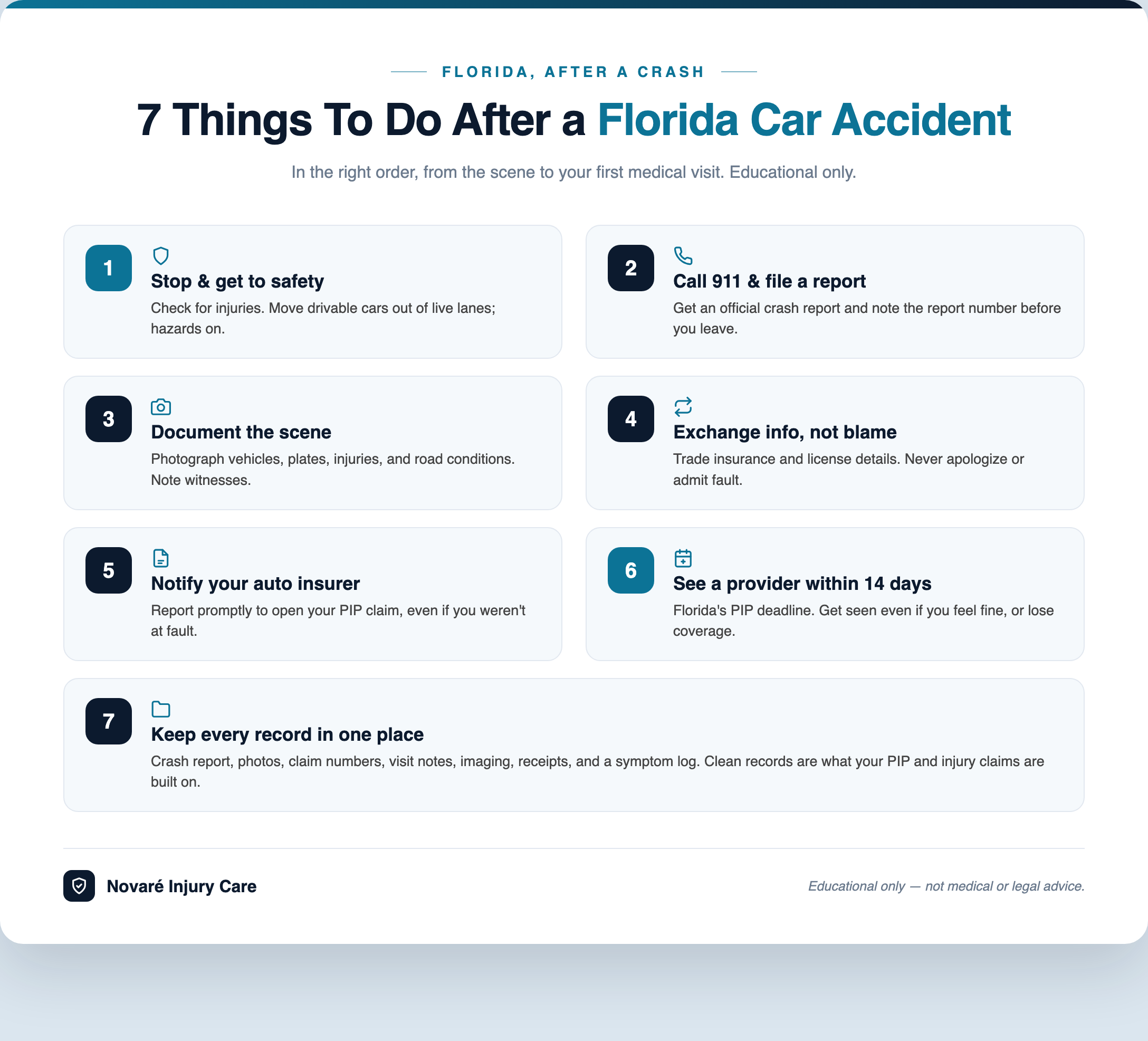
Give your insurer the facts: the date, location, and a straightforward account of what happened. Be honest and be brief. Be cautious about giving a recorded statement to the other driver's insurer, especially before you understand your injuries, and consider speaking with a licensed attorney first. The infographic below lays out this whole sequence as a checklist you can save.
6. See a qualified provider within 14 days
This is the step people skip, and it is the one that costs them. To be eligible for PIP medical benefits, Florida law generally requires that you receive initial care from a qualified provider, such as a physician, chiropractor, dentist, or hospital, within 14 days of the crash. Wait longer than 14 days, and you can lose access to your PIP medical benefits entirely, even when your injuries are genuine and clearly crash-related.
Get seen even if you feel fine. Adrenaline masks pain in the hours right after a collision, and injuries like whiplash, soft-tissue strains, and disc problems frequently show up a day or two later. A prompt evaluation does two things at once: it catches hidden injuries before they worsen, and it creates a clear medical record connecting your symptoms to the accident. A gap between the crash and your first visit is one of the first things an insurer looks for.
Early care is also cleaner clinically. First-visit diagnostic imaging helps pin down what is actually injured rather than guessing, and starting treatment early tends to make recovery more straightforward. If your injuries need ongoing hands-on care, that is where chiropractic and manual therapy, whiplash treatment, and spinal decompression for disc injuries come in.
7. Keep every record in one place
From day one, keep a single folder, digital or paper, for everything related to the crash. That includes the crash report number, photos, your insurer's claim number, provider visit notes, imaging, receipts, and a simple log of your symptoms and missed work.
Good records protect you twice. Clinically, a symptom log helps your provider track recovery and adjust treatment. On the coverage and legal side, organized documentation is what a PIP claim and any injury claim are built on. PIP generally pays 80% of reasonable and necessary medical bills and 60% of lost wages up to the policy limit, and clean records make it far easier to access what you are owed. Access to the full $10,000 minimum can depend on whether a qualified provider determines you have an emergency medical condition (EMC), which is documented as part of your care.
A note on scope: this article explains what generally happens after a Florida crash. It is educational, not medical or legal advice. For your specific injuries and your specific policy, rely on a qualified provider and a licensed attorney.
The questions we hear most from Florida crash patients, answered in plain language.
Hurt in a crash? Start your accident care today
You do not have to work through this alone, and you should not let the 14-day clock run out while you decide. If you have been in a car accident in Southwest Florida, our auto accident care team in Fort Myers and Lehigh Acres offers same-day and next-day appointments, in-house imaging, and the documentation your PIP claim needs. Call our Fort Myers office at (239) 893-2225 to get seen quickly and protect both your recovery and your coverage.
This article was reviewed by Dr. Ivan Bracic, DC, founder and clinical director of Novaré Injury Care and Rehab in Fort Myers and Lehigh Acres, Florida. Trauma Team certified and a Certified Independent Chiropractic Examiner, Dr. Bracic has spent more than 30 years caring for injury patients and documenting crash-related cases.
Frequently asked questions
What should I do immediately after a car accident in Florida?
Stop and check for injuries, then move to safety if the vehicles are drivable and blocking traffic. Call 911 so police and, if needed, paramedics respond. Exchange driver, vehicle, and insurance information with the other driver, photograph the scene and damage, and get the crash report number. As soon as you can, arrange a medical evaluation, because Florida's PIP benefits generally require you to be seen within 14 days.
Do I have to call the police after a minor accident in Florida?
Florida law generally requires reporting a crash to law enforcement when there is injury, death, or apparent property damage of at least $500, which most collisions meet. Even for a seemingly minor fender bender, an official crash report creates an objective record that helps your PIP claim and any injury claim. When in doubt, call and let the officer decide whether a report is needed.
How long do I have to see a doctor after a car accident in Florida?
To be eligible for Personal Injury Protection (PIP) medical benefits, Florida law generally requires you to receive initial care from a qualified provider, such as a physician, chiropractor, dentist, or hospital, within 14 days of the accident. Miss that window and you can lose access to your PIP medical benefits even if your injuries are real, so prompt evaluation matters.
Should I see a doctor if I feel fine after a crash?
Yes. Adrenaline can mask pain for hours or days after a collision, and injuries like whiplash, soft-tissue strains, and disc problems often show up later. A prompt evaluation catches hidden injuries early and creates a clear record linking any symptoms to the crash, which protects both your recovery and your PIP eligibility within the 14-day window.
What should I not do after a car accident in Florida?
Do not leave the scene, admit fault, or downplay your injuries at the scene, and do not skip a medical evaluation because you feel okay. Avoid giving a recorded statement to the other driver's insurer or accepting a quick settlement before you understand your injuries. When you are unsure, get evaluated by a provider and talk to a licensed attorney before making decisions.