
If sciatica has your low back and leg aching, gentle movement often helps more than lying still, and a handful of slow stretches may ease the nerve pain for many people. I'm Dr. Ivan Bracic, and I've treated sciatica for more than 30 years across Illinois and here in Southwest Florida. Below are the gentle exercises I most often walk patients through, with plain how-to and clear rules for when to stop. If your pain is severe or not improving, our team offers sciatica evaluation and treatment in Fort Myers and Lehigh Acres.
First, a word that matters more than any single move. This article is general education, not a prescription. Sciatica is a symptom, not a diagnosis, and the right exercise depends on what is actually pressing on or irritating the nerve. So treat what follows as a starting point to discuss with a provider, not a program to push through on your own.
Which sciatica exercises tend to help
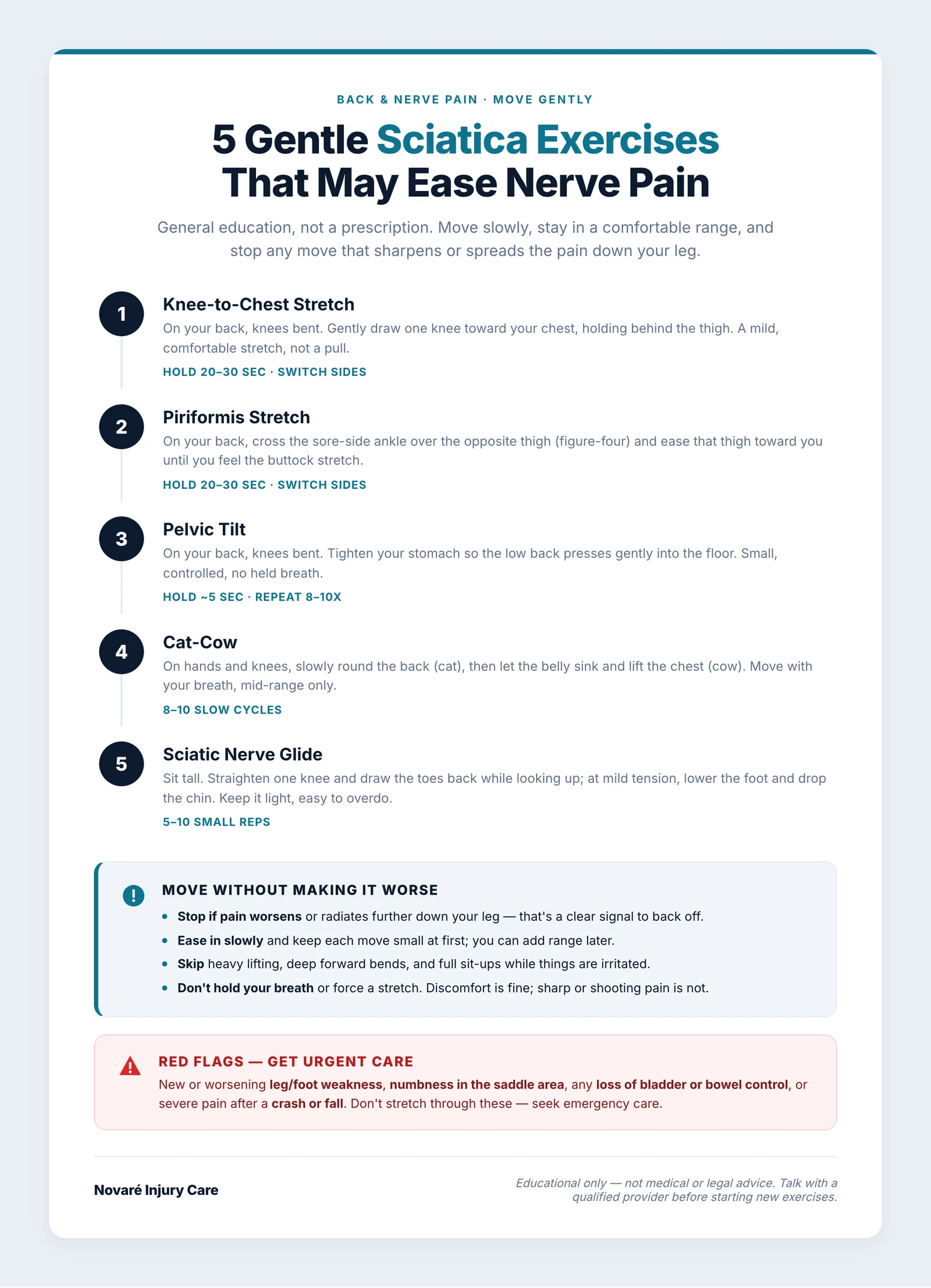
For many people, the most useful sciatica exercises are gentle ones that reduce tension around the nerve and keep the low back moving. Common choices are the knee-to-chest stretch, the piriformis stretch, the pelvic tilt, cat-cow, and a light sciatic nerve glide.
The idea is not to muscle through pain. It's to move slowly, stay within a comfortable range, and give the irritated nerve room to calm down. Some people feel better with gentle flexion, others with extension, which is exactly why a real evaluation beats guesswork.
Below, I'll walk through five moves I use often. Go slow, breathe, and read the safety section before you start.
1. Knee-to-chest stretch
This is a soft opener that eases tension in the low back and glutes.
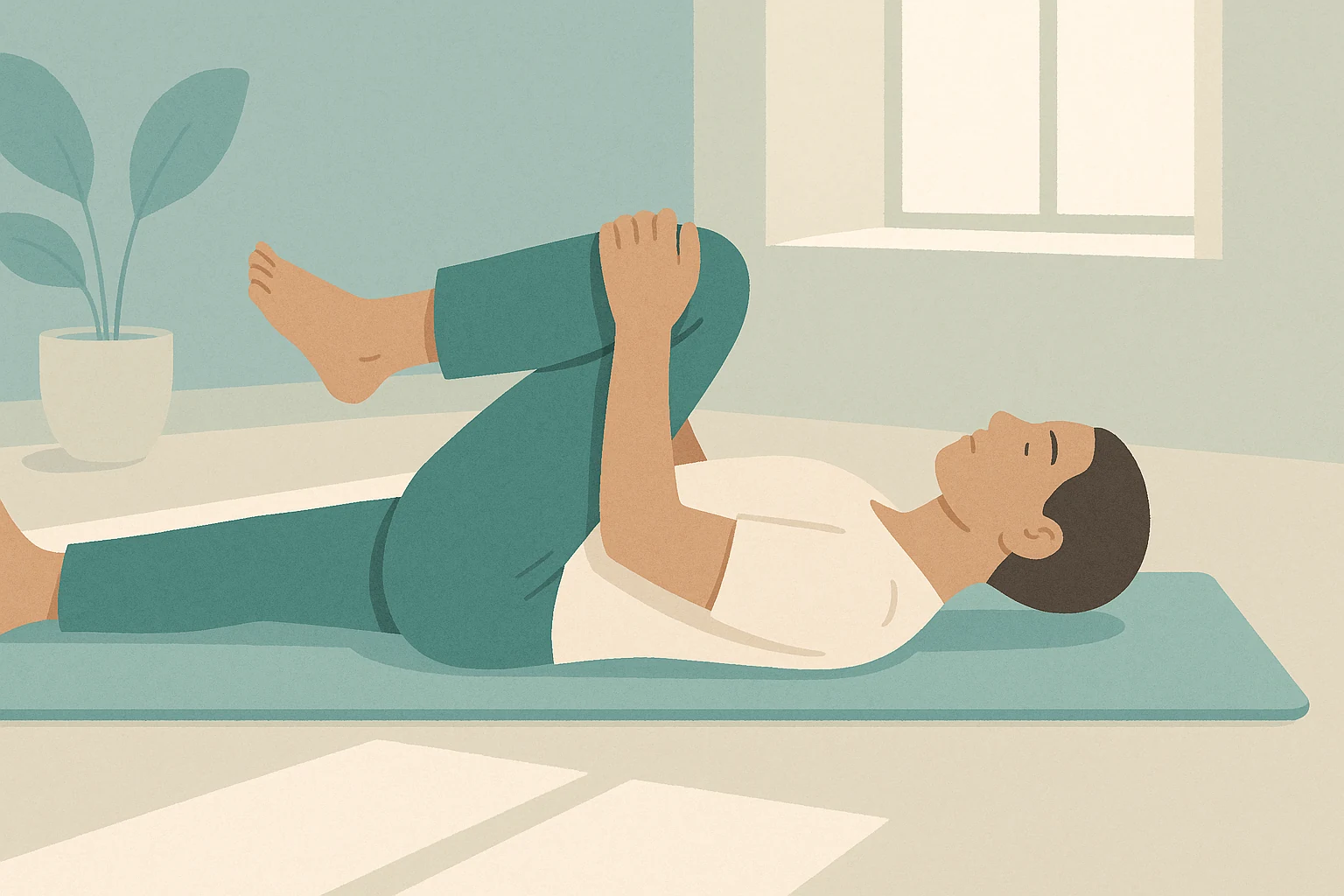
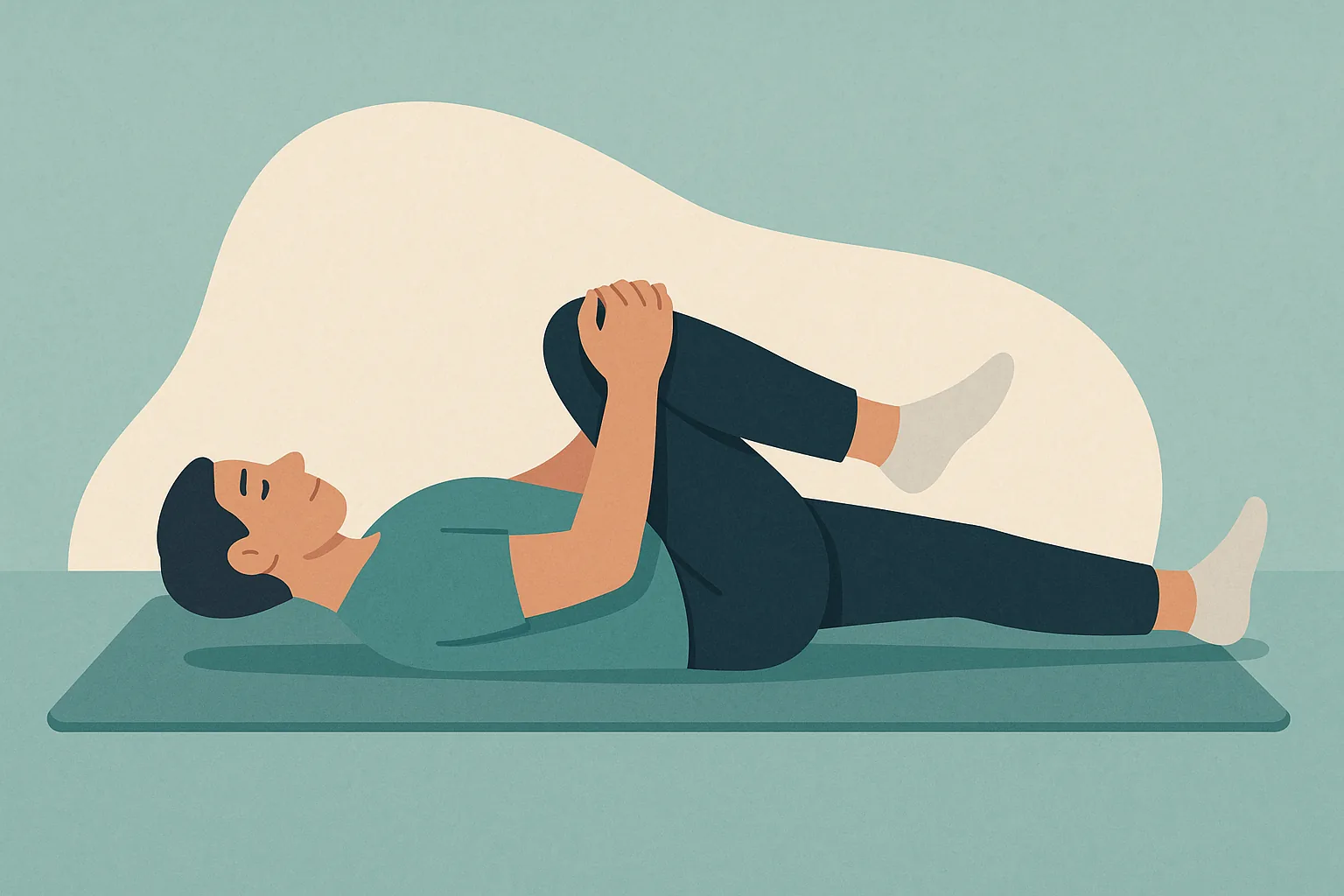
Lie on your back with both knees bent and feet flat. Gently bring one knee up toward your chest, holding behind the thigh with both hands. Hold for about 20 to 30 seconds, breathing easily, then lower and switch sides.
Keep the movement slow and small. You want a mild, comfortable stretch, not a pull. If bringing the knee up sends pain down your leg, ease off or skip this one.
2. Piriformis stretch
The piriformis is a small muscle deep in the buttock, and when it is tight it can irritate the sciatic nerve nearby. A gentle stretch here helps a lot of people.
Lie on your back with both knees bent. Cross the ankle of the painful side over the opposite thigh, making a figure-four shape. Reach through and gently pull the bottom thigh toward you until you feel a stretch in the buttock. Hold 20 to 30 seconds and switch sides.
You can also do a seated version in a chair by crossing one ankle over the opposite knee and leaning forward with a tall back. Keep it gentle either way.
3. Pelvic tilt
The pelvic tilt is a small, low-effort move that wakes up the core and takes pressure off the low back.
Lie on your back with knees bent and feet flat. Tighten your stomach muscles so your low back presses gently into the floor, tilting your pelvis slightly upward. Hold for about five seconds, then relax.
Repeat 8 to 10 times, keeping the motion small and controlled. There should be no strain and no held breath. This one is usually well tolerated even on tougher days.
4. Cat-cow
Cat-cow keeps the spine moving through a gentle range and often feels good when the back is stiff.
Start on your hands and knees, wrists under shoulders and knees under hips. Slowly round your back toward the ceiling and drop your head (the cat). Then reverse, letting your belly sink and lifting your chest and tailbone slightly (the cow). Move with your breath.
Do 8 to 10 slow cycles. Stay in the middle of the range that feels comfortable. If either direction sharpens your symptoms, shrink the movement or stop.
5. Sciatic nerve glide
A nerve glide, sometimes called nerve flossing, gently mobilizes the sciatic nerve. It can help some people, but it is easy to overdo, so keep it light.
Sit tall in a chair. Slowly straighten one knee and pull your toes back toward you while looking up slightly. When you feel a mild tension down the leg, gently lower the foot and drop your chin. That back-and-forth glide is one rep.
Do 5 to 10 slow, small reps. This should feel like a light stretch and release, never a sharp or lasting pain. If it flares your symptoms, set it aside and mention it at your next visit.
Safety first: how to move without making things worse
Gentle sciatica exercises are meant to soothe the nerve, not test it, so a few rules keep them safe for most people.
- Ease in slowly and keep every movement small at first. You can always add range later.
- Stop any move that increases your pain or sends it further down your leg. More pain or more radiating pain is a clear signal to back off.
- Skip heavy lifting, deep forward bends, and full sit-ups while things are irritated.
- Don't hold your breath or force a stretch. Discomfort is fine; sharp or shooting pain is not.
- Be patient. Consistency over days and weeks tends to help more than one hard session.
If gentle movement consistently makes your pain worse instead of better, that itself is useful information. It usually means the underlying cause needs a closer look before you keep exercising.
Red flags: when to get urgent care
Most sciatica is not dangerous, but a few symptoms are. Get emergency medical care right away if you notice any of these.
- New or worsening weakness in a leg or foot, or trouble lifting your foot.
- Numbness in the saddle area, meaning the inner thighs, groin, or area you'd sit on.
- Any loss of bladder or bowel control, or difficulty starting to urinate.
- Severe pain after a major trauma like a car crash or a fall from height.
These can point to a serious problem such as cauda equina syndrome, and they are not something to stretch through or wait on. When in doubt, get seen.
Getting to the cause, not just the symptom
Exercises can ease a flare, but sciatica keeps coming back when the underlying cause goes unaddressed. A herniated disc, spinal narrowing, and a tight piriformis all cause similar leg pain and call for different care.
That's where an evaluation earns its keep. At Novaré Injury Care and Rehab, we start by pinning down the source, often with in-house diagnostic imaging, then build a plan around it. For many patients that includes chiropractic and manual therapy and, for disc-related nerve pain, spinal decompression. If your sciatica started after a crash, early care also creates the record your claim may need.
A note on scope: this article explains gentle exercises that may help sciatica for many people. It is educational, not medical advice, and it is not a prescribed program. For your specific pain, rely on a qualified provider.
The questions I hear most from patients dealing with sciatica, answered in plain language.
Sciatica that won't quit? Let's find out why
You don't have to keep guessing at which stretch might help. If your sciatica is severe, keeps coming back, or isn't improving with gentle care, get it evaluated. Our team offers sciatica evaluation and treatment in Fort Myers and Lehigh Acres, with imaging and a plan built around your specific injury. Call our Fort Myers office at (239) 893-2225 to get seen and find real relief.
This article was reviewed by Dr. Ivan Bracic, DC, founder and clinical director of Novaré Injury Care and Rehab in Fort Myers and Lehigh Acres, Florida. Trauma Team certified and a Certified Independent Chiropractic Examiner, Dr. Bracic has spent more than 30 years treating back and nerve pain, including many patients with sciatica.
Frequently Asked Questions
What are the best gentle exercises for sciatica?
For many people, gentle options include the knee-to-chest stretch, a seated or lying piriformis stretch, the pelvic tilt, cat-cow, and a light sciatic nerve glide. These aim to reduce tension around the nerve and keep the low back moving without straining it. What helps depends on what is actually causing your sciatica, so it is worth getting evaluated first. Move slowly, breathe, and stop any movement that sharpens or spreads the pain down your leg.
Should I exercise or rest when sciatica flares up?
In most cases, gentle movement beats extended bed rest for sciatica, because staying still too long can stiffen the back and slow recovery. Short walks and easy stretches keep things moving. That said, a bad flare may need a day or two of relative rest before you ease back in. Let pain be your guide, avoid heavy lifting and deep bending during a flare, and check with a provider if the pain is severe or not improving.
How long does it take for sciatica exercises to work?
It varies a lot from person to person. Many people notice their symptoms calm down over a few weeks of consistent, gentle work, while others need longer or need a different approach entirely. There is no guaranteed timeline. If your leg pain, numbness, or weakness is getting worse, or you see no change after a few weeks, that is a sign to be evaluated rather than pushing harder on your own.
What exercises should I avoid with sciatica?
During a flare, it is generally wise to avoid heavy lifting, deep forward bends that round the low back, full sit-ups, and high-impact activity that jars the spine. Twisting under load and prolonged sitting can also aggravate the nerve. None of these are banned forever, but they tend to provoke symptoms while the nerve is irritated. If a movement sends pain shooting down your leg, that is your signal to back off.
When should I see a doctor for sciatica?
See a provider promptly if leg pain is severe, keeps getting worse, or does not improve with gentle care. Certain symptoms are urgent: new or worsening weakness in a leg or foot, numbness in the saddle area between the legs, or any loss of bladder or bowel control. Those can signal a serious problem and need emergency evaluation. If your sciatica started after a car accident or a fall, get checked early so the cause is identified and documented.
This article is educational and is not medical advice. It is general information, not a prescribed exercise program. Talk with a qualified provider before starting new exercises, and get prompt care for any new weakness, numbness, or loss of bladder or bowel control.