
A bulging disc spreads past its normal edge while its tough outer ring stays intact. A herniated disc is different, because the soft center pushes out through a tear in that ring. Either one can cause no pain at all, or it can press on a nerve, so the label on your MRI report matters less than what your exam shows. Our herniated disc treatment in Fort Myers starts by matching the imaging to your symptoms.
What is the difference between a herniated and bulging disc?
The difference is whether the disc's outer ring has torn. According to AAOS OrthoInfo, a herniated disc happens when the soft, jelly-like center pushes through the tough outer ring, and disc material can either break through the ring or make it bulge. If your report uses either word, ask your provider which nerve, if any, it's touching.
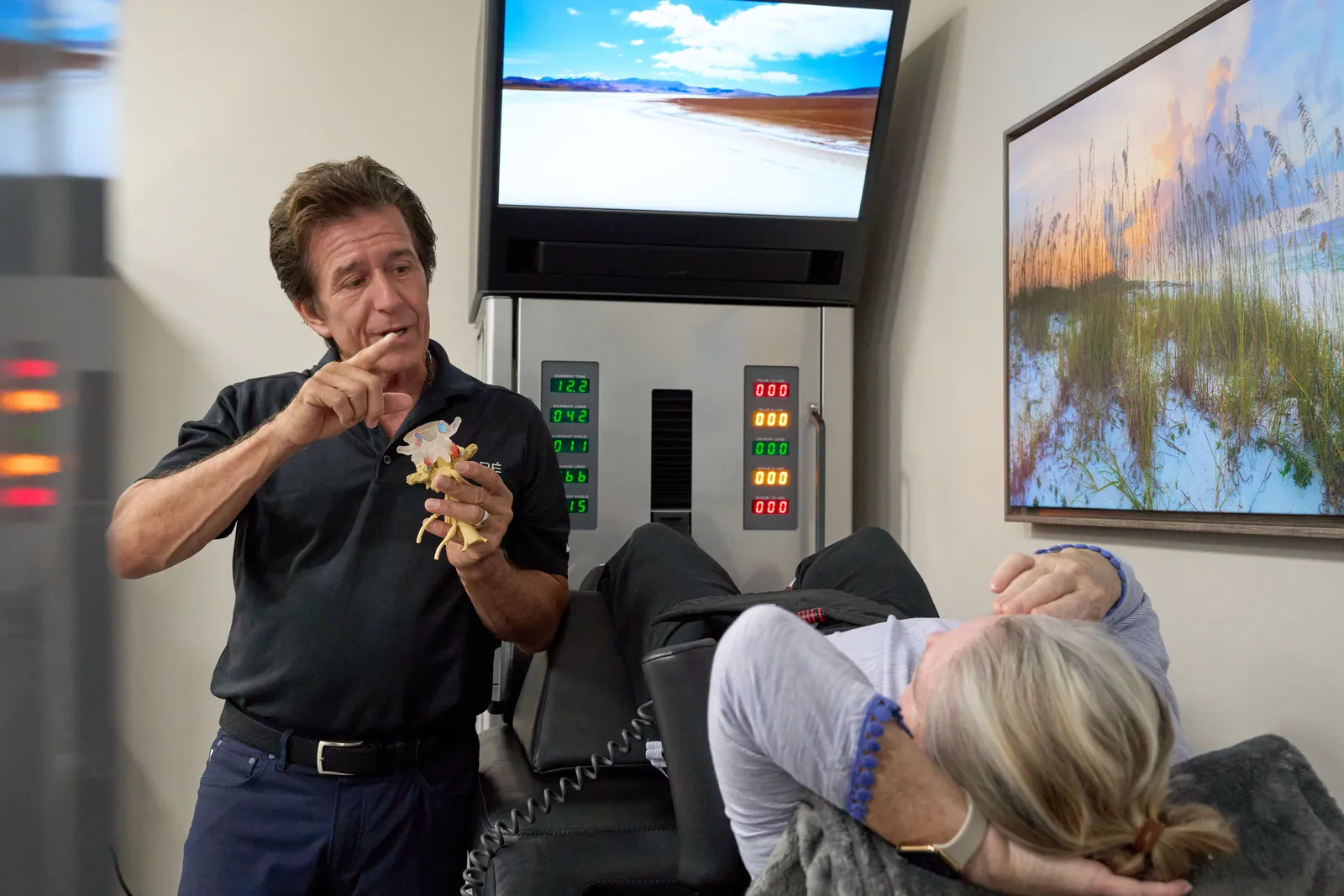
I'm Dr. Ivan Bracic, DC, founder of Novaré Injury Care and Rehab in Fort Myers. I've cared for more than 30,000 patients across Illinois and Florida since 1994, and I've read a lot of MRI reports with worried patients. I have post-graduate training in reading MRIs, and I mark up the images with patients so they can see what the words mean.
The picture I use in the clinic is a jelly donut. A bulging disc is the donut squashed flat so it spreads a little wider all around. A herniated disc is the jelly squeezing out of a crack on one side.
How a spinal disc is built
Each disc sits between two vertebrae and works as a cushion and a joint. Per AAOS, it has two parts:
-
The annulus, a tough, flexible outer ring.
-
The nucleus, a soft, jelly-like center.
As we age, discs dry out and the outer ring gets less springy. That's part of why disc findings become so common on imaging as people get older.
Why so many MRI reports mention disc bulges
Disc bulges show up on many scans of people who feel fine. A 2015 systematic review in the American Journal of Neuroradiology by Brinjikji and colleagues looked at people with no history of back pain. Disc bulges were found in 30% of 20-year-olds and 84% of 80-year-olds. Disc protrusions, a type of herniation, were found in 29% of 20-year-olds and 43% of 80-year-olds.
That's the most reassuring number I share with patients. A bulge on your report may have been there for years before your pain started. The job is to find out whether it explains your symptoms or is simply along for the ride.
Herniated disc vs bulging disc at a glance
This table sums up how the two usually compare. Your own disc may not fit the pattern neatly, which is why an exam matters.
| Feature | Bulging disc | Herniated disc |
|---|---|---|
| Outer ring | Intact | Torn |
| Shape | Spreads wide around the disc edge | Pushes out in one spot |
| Found in people without pain | Very common, rising with age | Common, rising with age |
| Typical nerve symptoms | Less common | More common when it touches a nerve root |
| First line of care | Nonsurgical | Nonsurgical |
Bulging and herniated disc symptoms
Either one can cause no symptoms at all. When a disc does irritate a nerve, AAOS lists these signs for the lower back:
- Back pain. Often the first symptom.
- Sciatica. A sharp, shooting pain from the buttock down the back of one leg.
- Numbness or tingling. In the leg or foot.
- Weakness. In the leg or foot muscles that nerve controls.
In the neck, the same problem sends symptoms into the shoulder, arm or hand instead. In my experience, herniations are more often behind sharp nerve pain, because the material sits in one spot close to a nerve root. A broad bulge can still narrow the space for nerves, especially when bone spurs or thickened ligaments are crowding the same area.
Imaging that tells a herniation from a bulge
MRI is the test that shows the discs. AAOS notes that MRI gives clear images of soft tissues, including discs, and that a CT scan with dye can stand in when someone can't have an MRI. X-rays show bone, alignment and the spacing between vertebrae, but not the disc itself.
Imaging is only half the answer. The report tells me what's there. The exam tells me whether it's the cause. I check strength, reflexes and sensation, and I see which movements bring on your pain. When the MRI and the exam point to the same nerve, I trust the finding a lot more.
Care options for a bulging or herniated disc
The first line of care is usually the same for both. AAOS says first treatment for a herniated disc is usually nonsurgical, and that most people feel better within a few weeks or months without surgery. Options it lists include a short rest of a day or two, anti-inflammatory medicine, physical therapy and epidural steroid injections.
At our clinic, care depends on your exam and imaging. It may include chiropractic adjustments, flexion-distraction on specialized tables, spinal decompression, laser therapy and rehab exercises. I explain why I'm recommending each one and how we'll judge whether it's working. If your case needs a surgeon's opinion, we refer to a neurosurgery network we trust.
What you do between visits counts too. My guide on whether herniated discs heal covers the usual recovery timeline, and five ways to stay active with a herniated disc covers daily habits. I also cover the habits to stop in a short video on what not to do with a herniated disc.
Disc red flags that need the ER
Most disc problems are safe to treat in the office. Some symptoms are not. AAOS calls loss of bladder or bowel control a sign of cauda equina syndrome, which is a medical emergency. In my practice, I send people straight to the emergency room for any of these:
-
New loss of bladder or bowel control.
-
Numbness between the legs or in the inner thighs.
-
Weakness in a leg or arm that is getting worse quickly.
-
Severe back or neck pain after a serious fall or crash.
These are uncommon. Knowing them means you can stay calm about the ordinary aches of a disc problem and act fast on the rare signs that can't wait.
Disc exams at our Fort Myers clinic
If you already have an MRI, coordinate with our front desk so I can review the images before your visit. I'll go over them with you, mark what matters and compare them with your exam. If you don't have one, I'll examine you, take digital X-rays on site, and order an MRI if your exam calls for it.
Your first visit typically runs 1 to 1.5 hours, and most of that time is with me. You'll leave knowing whether your disc finding explains your pain and what we'll do about it.
See herniated disc treatment in Fort Myers
The questions I hear most about bulging and herniated discs, answered plainly.
Dr. Ivan Bracic, DC, is the founder and clinical director of Novaré Injury Care and Rehab in Fort Myers and Lehigh Acres, Florida. He has cared for more than 30,000 patients across Illinois and Florida since 1994 and is Trauma Team certified.
- How decompression works on a disc: spinal decompression in Fort Myers.
Frequently Asked Questions
Is a bulging disc worse than a herniated disc?
Not usually. A bulge keeps the disc's outer ring intact, while a herniation means the soft center has pushed through it, per AAOS. What matters most is whether either one is pressing on a nerve, so judge it by your symptoms and exam, not the label alone.
Can a bulging disc turn into a herniated disc?
It can. AAOS describes disc material either pushing all the way through the outer ring or causing the ring to bulge, so the two sit on the same spectrum. Avoid long hours of sitting and heavy lifting while a disc is irritated, and get checked if your symptoms change.
Do bulging discs always cause pain?
No. A 2015 review found disc bulges in 30% of 20-year-olds and 84% of 80-year-olds who had no history of back pain. If your MRI mentions a bulge, ask whether it actually matches where you hurt.
Will I need surgery for a herniated disc?
Most people don't. AAOS says most people feel better within a few weeks or months without surgery, and that first treatment is usually nonsurgical. Surgery is usually considered when that care fails or when weakness or trouble walking shows up.
Can an X-ray show a herniated or bulging disc?
Not directly. AAOS notes MRI is the test that gives clear images of soft tissues, including the discs. X-rays still help me check alignment and the space between vertebrae, so I use both when the exam calls for it.
This article is educational and is not medical advice or a diagnosis. If you have back or neck pain with numbness, weakness, or pain that travels down an arm or leg, get evaluated by a qualified provider. Loss of bladder or bowel control, or numbness between the legs, needs emergency care right away.