
I'm Dr. Ivan Bracic, and I've spent more than 30 years helping crash patients in Illinois and Southwest Florida, including thousands of accident and legal cases. The question I hear most in my Fort Myers office is simple: what does PIP insurance cover? In Florida, Personal Injury Protection generally pays up to $10,000 after a car accident no matter who caused it, covering the bulk of your medical bills and part of your lost wages. If you were hurt in a crash, our team at Novaré Injury Care & Rehab provides same-day auto accident care in Fort Myers and Lehigh Acres and handles the PIP documentation your claim needs.
Florida is a no-fault state, so your own PIP is the coverage that pays first after almost any crash. People confuse what it covers with how it works, and that confusion costs them money. This article stays on one question: what actually comes out of that $10,000, and what doesn't. If you want the mechanics of no-fault versus your health plan, read our companion piece on how PIP and health insurance work together. Here, I'm listing exactly what PIP pays for and what it won't.
What does PIP insurance cover in Florida?
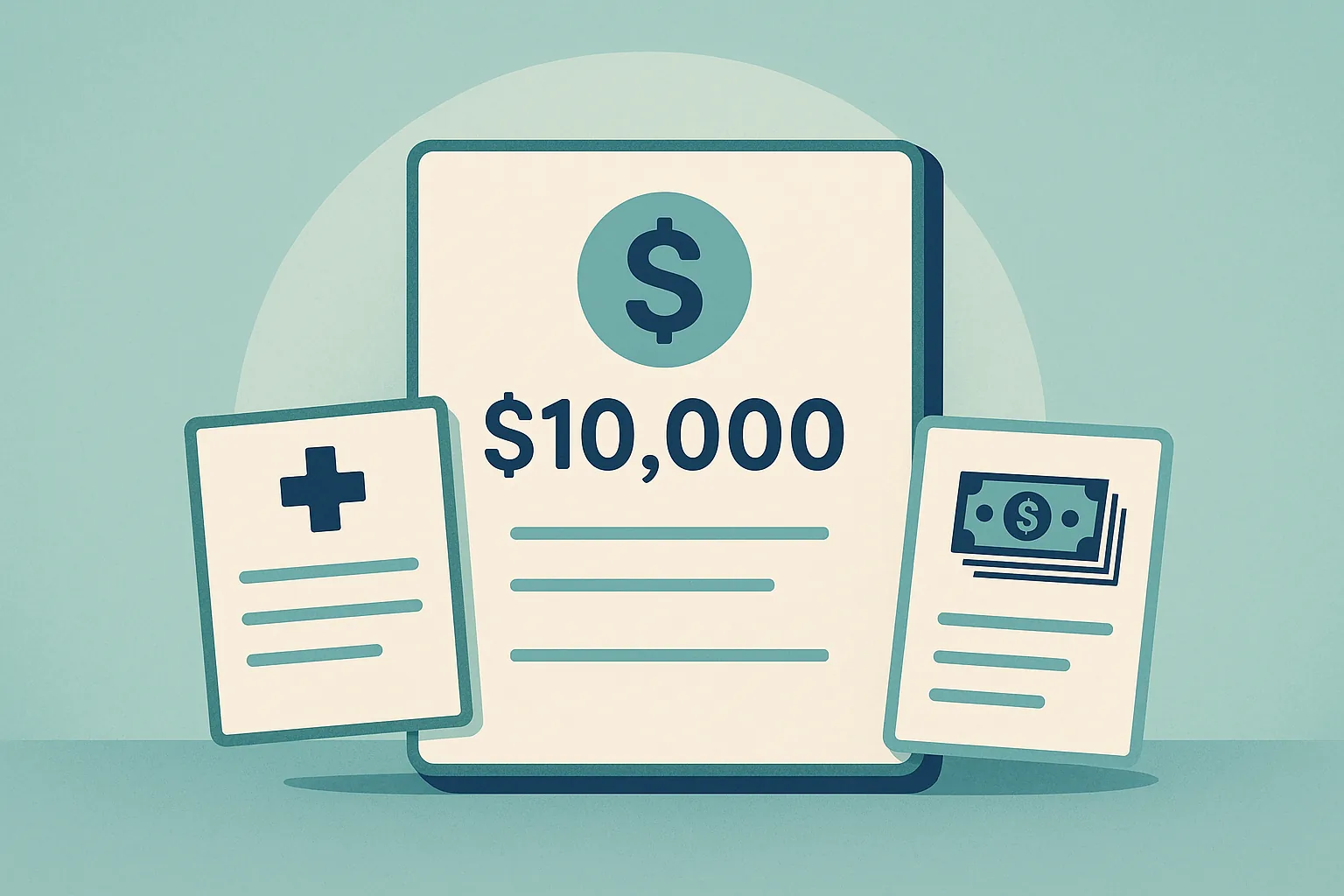
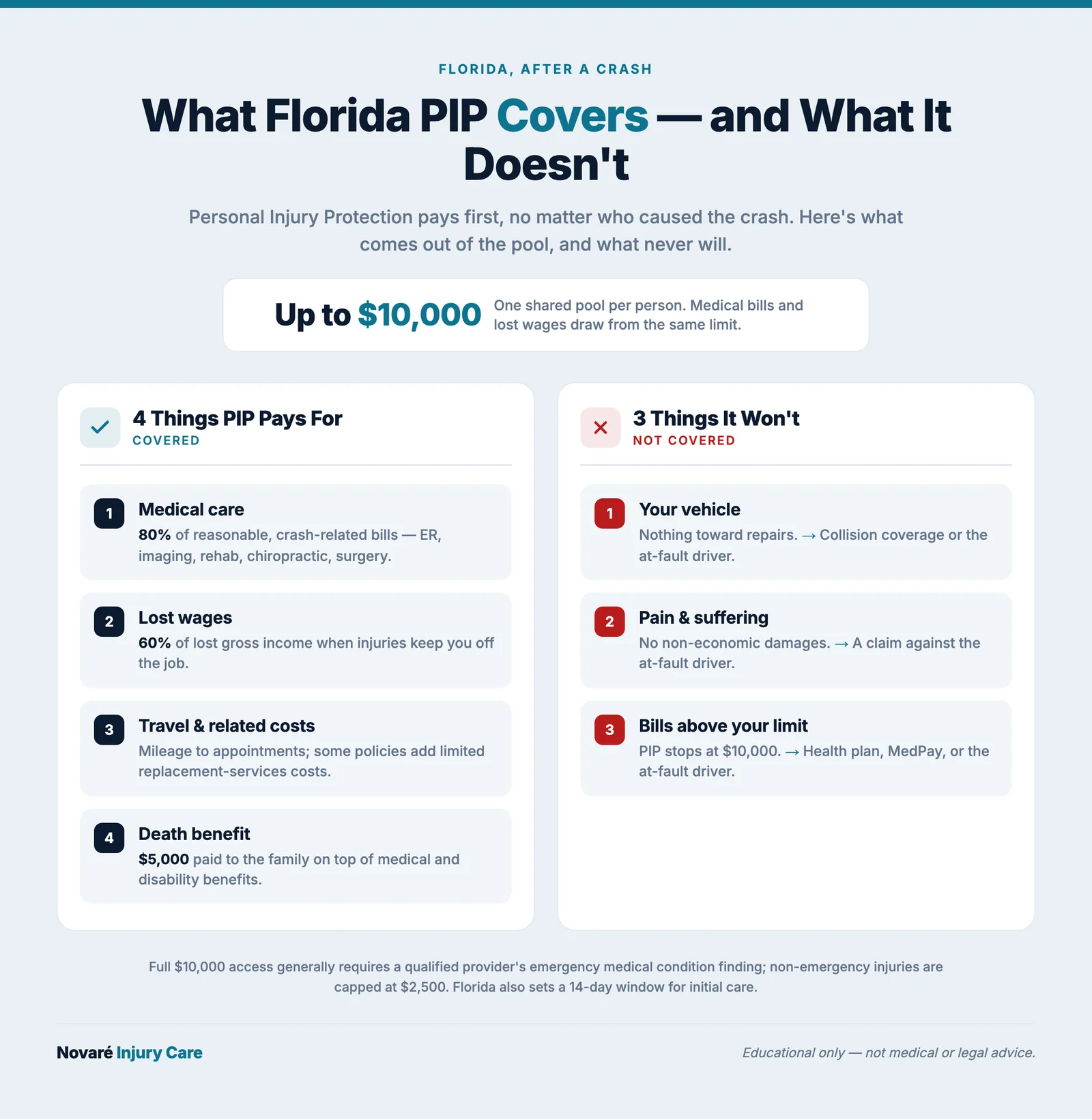
Florida PIP generally covers up to $10,000 per person after a car accident, regardless of fault. That pool pays 80% of reasonable and necessary medical expenses, 60% of lost wages, mileage to appointments, and a death benefit. It does not cover vehicle repairs or pain and suffering.
Per the Florida Office of Insurance Regulation, every registered vehicle in the state must carry at least $10,000 in PIP. The important nuance is that the money is shared across all covered expenses, so medical bills and lost wages draw from the same limit. Below are the four things PIP does pay for, then the three big things it doesn't.
1. Emergency and follow-up medical care
This is the heart of PIP. It generally covers 80% of reasonable and necessary medical bills tied to the crash, including the emergency room, imaging, physician visits, physical rehabilitation, chiropractic care, and surgery when it's needed. Your provider bills PIP directly in most cases.
Two limits shape how much of that $10,000 you can actually reach. First, PIP pays 80%, so 20% of covered bills stays with you or a coordinating health plan. Second, and this is the one that surprises people, the full $10,000 is only available when a qualified provider determines you have an emergency medical condition. Without that EMC determination, your medical benefit is generally capped at $2,500.
Early, well-documented care is how that determination gets made honestly and on time. In my Fort Myers office, the patients who preserve their full benefit are almost always the ones seen within days of the crash, not weeks later. A clean record early keeps the door open to the whole limit if your injuries turn out to be serious.
2. Lost wages when you can't work
If a crash injury keeps you off the job, PIP generally replaces 60% of your lost gross income, drawn from the same $10,000 limit. You'll usually need a provider's note documenting your work restrictions and proof of what you normally earn.
Here's the trade-off patients don't see coming. Because medical bills and wage replacement share one pool, a heavy run of medical treatment can leave little room left for lost wages, and the reverse is true too. I mention it so you can plan ahead.
Keep a simple log of missed shifts and get your work-status documentation early, because reconstructing it weeks later is much harder. If you're self-employed or paid in tips, gather your own earnings proof up front, since your insurer can't guess what a normal week looks like for you.
3. Travel and related out-of-pocket costs
PIP generally reimburses mileage to and from your medical appointments, which adds up over a course of rehab. Depending on your specific policy, some plans may also reimburse limited replacement-services costs for essential tasks you normally do yourself but can't while injured, like childcare or housework, so it is worth confirming what your policy includes.
These are smaller line items, and they still come out of the $10,000. Save receipts and keep a mileage log from your first visit. The patients who get reimbursed fully are the ones who documented as they went, not the ones who tried to remember it all at the end.
4. A death benefit for the family
In the event a crash is fatal, Florida PIP generally provides a $5,000 death benefit paid on top of the medical and disability benefits already used. It's meant to help a surviving family with immediate costs during an impossible time.
This benefit is separate from any wrongful-death claim a family might have against an at-fault driver. Those are very different legal questions, and they belong with a licensed attorney, not with your PIP adjuster. I include it here only because families often don't know the benefit exists.
5. What PIP does not cover: your vehicle
PIP is health coverage for people, not property. It pays nothing toward repairing or replacing your car, no matter who caused the crash. That's a common and costly misunderstanding.
For vehicle damage, you look to your collision coverage or a property-damage claim against the at-fault driver. Keep those two claims mentally separate: one folder for your injuries and PIP, another for your car. Mixing them up is how people miss a deadline or under-document one side of the accident.
6. What PIP does not cover: pain and suffering
PIP pays for measurable economic losses, your bills and your wages, and nothing for non-economic harm like pain, suffering, or reduced quality of life. Those damages simply aren't part of no-fault coverage.
Recovering for pain and suffering generally requires a claim against the at-fault driver, and Florida sets a threshold for when that's even possible, usually tied to significant or permanent injury. Whether your situation qualifies is a legal judgment, not a medical one. If you think you may have a claim beyond PIP, talk to a licensed attorney early, and let your medical records tell the honest story of your injuries.
7. What PIP does not cover: bills above your limit
Once you've used the $10,000, or the $2,500 non-emergency cap, PIP stops. Serious injuries can exceed that quickly, and PIP was never designed to be your only coverage in a bad crash.
When bills run past your limit, the remaining balance can fall to your health insurance, MedPay if you carry it, or a claim against the at-fault driver. This is exactly where the deductible you chose and any coordinating health plan start to matter. It's also where a thorough first-visit evaluation with diagnostic imaging protects you, because a clear, early record of your injuries is what every one of these follow-on claims is built on.
A note on scope: this explains what Florida PIP generally covers, stated carefully. It is educational, not medical or legal advice. For your specific injuries and your exact policy, rely on a qualified provider and a licensed attorney.
The PIP coverage questions I hear most from Southwest Florida crash patients, answered plainly.
Not sure what your PIP will cover? Get evaluated first
You can't make good decisions about coverage until you know what's actually injured, and the 14-day clock is running. If you were hurt in a crash in Southwest Florida, our auto accident care team in Fort Myers and Lehigh Acres offers same-day and next-day appointments, in-house imaging, and the documentation your PIP claim needs. Call our Fort Myers office at (239) 893-2225 to get seen quickly and protect both your recovery and your coverage.
This article was reviewed by Dr. Ivan Bracic, DC, founder and clinical director of Novaré Injury Care & Rehab in Fort Myers and Lehigh Acres, Florida. Trauma Team certified and a Certified Independent Chiropractic Examiner, Dr. Bracic has spent more than 30 years documenting crash-related injuries and supporting thousands of accident and legal cases, which is exactly the coverage work PIP claims depend on.
Frequently asked questions
What does PIP insurance cover in Florida?
Florida PIP generally covers up to $10,000 per person after a car accident, no matter who caused it. That limit typically pays 80% of reasonable and necessary medical bills, 60% of lost wages from crash-related injuries, and mileage to appointments. It also includes a $5,000 death benefit. PIP does not pay for vehicle repairs or for your pain and suffering, and access to the full $10,000 generally depends on a qualified provider determining you have an emergency medical condition.
How much does Florida PIP pay for medical bills?
PIP generally pays 80% of reasonable and necessary medical expenses tied to the crash, up to the policy limit. If a qualified provider determines you have an emergency medical condition (EMC), you can access the full $10,000. Without an EMC determination, your medical benefit is generally capped at $2,500. The remaining 20% is your responsibility unless another coverage picks it up, so it helps to understand your deductible and any coordinating health plan.
Does PIP cover the other driver or my passengers?
PIP is personal coverage that follows you, your resident relatives, and generally passengers in your car who don't have their own PIP. It pays regardless of fault, which is why Florida calls it no-fault coverage. It does not pay the at-fault driver's bills, and it isn't the same as liability coverage. If your injuries exceed your PIP limit, recovering more usually means a claim against the at-fault driver, which is a conversation for a licensed attorney.
Does PIP pay for lost wages after a car accident?
Yes. Florida PIP generally covers 60% of lost gross income when a crash-related injury keeps you from working, counted within your overall $10,000 limit. You'll typically need documentation, such as a provider's note taking you off work and proof of your earnings. Because lost wages and medical bills share the same $10,000 pool, heavy medical use can leave less room for wage replacement, which is one more reason careful records matter.
What does PIP insurance not cover?
PIP does not cover your vehicle damage, your pain and suffering, or the portion of medical bills above your policy limit. It also generally won't pay if you miss Florida's 14-day window for initial care, and non-emergency injuries are capped at $2,500. For property damage you look to collision coverage or the at-fault driver, and for pain and suffering or bills beyond your limit you may need to pursue the at-fault driver with help from a licensed attorney.