

I'm Dr. Ivan Bracic, and I've spent more than 30 years treating injury patients, a lot of them right after a car crash here in Southwest Florida. The 5 most common whiplash symptoms I see are neck pain and stiffness, headaches, shoulder or upper-back pain, dizziness, and tingling or numbness into the arms. This article walks through each one, when to worry, and why getting seen early matters. If you were rear-ended or hit in Fort Myers or Lehigh Acres, our team offers whiplash evaluation and treatment and the documentation your PIP claim needs.
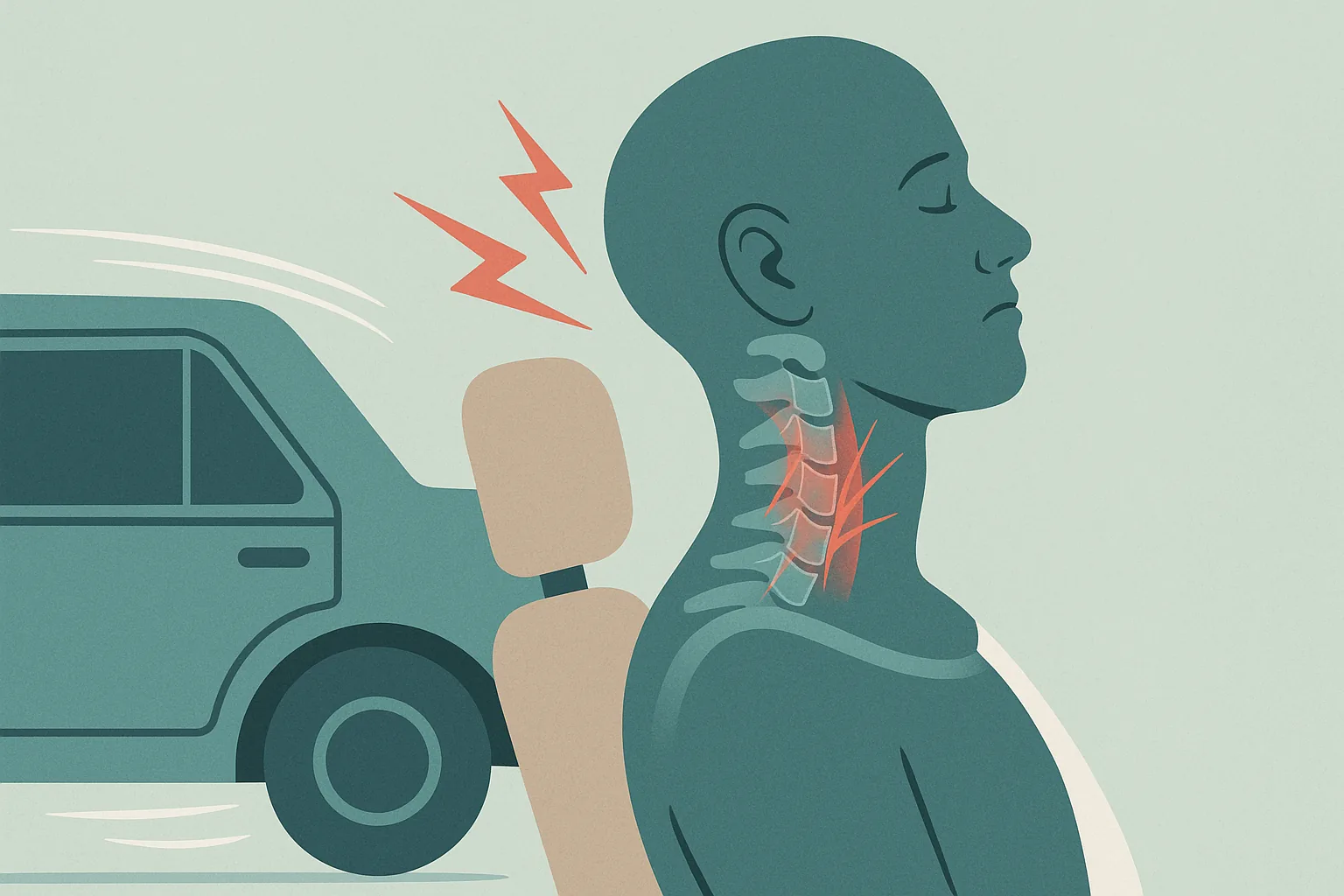
Whiplash is what happens when your head snaps forward and back faster than your neck can control, straining the muscles, ligaments, joints, and nerves. You do not need a dramatic wreck for it to happen. I've treated plenty of people from low-speed parking-lot bumps who woke up the next day barely able to turn their head.
Here's the part that surprises people most: the symptoms are often delayed. Adrenaline masks pain in the first hours, so you can walk away from a crash feeling fine and then feel much worse the next morning. That delay is exactly why I tell every crash patient to know what to watch for.
The short answer: what whiplash feels like
Whiplash usually shows up as neck pain and stiffness, headaches, shoulder or upper-back pain, dizziness, and tingling or numbness in the arms, alone or in combination. The Mayo Clinic describes whiplash as a neck injury from rapid back-and-forth motion, with symptoms that frequently develop within a day of the injury. Watch for these five signs in the first 72 hours after a crash, and get evaluated if any of them appear.
Not everyone gets all five, and you can have whiplash without classic neck pain. Let's go through each sign so you know what you're feeling and when it's time to be seen.
1. Neck pain and stiffness
This is the one most people expect, and it's the most common. It usually feels like a deep ache along the back and sides of the neck, with real trouble turning your head to check a blind spot or look over your shoulder. Some people describe it as their neck feeling "locked."
The pain often ramps up over the first day or two rather than peaking right away. If your neck felt fine at the scene and now feels tight, sore, or hard to move, that's textbook whiplash timing, not a sign it's minor. Gentle movement usually beats total rest, but it's worth having someone check your range of motion before you push it.
2. Headaches, often starting at the base of the skull
Whiplash headaches are one of the most common symptoms I see after neck pain itself. They typically start at the base of the skull and can wrap up and over toward the forehead or behind the eyes. These are called cervicogenic headaches, meaning they come from the neck.
A headache in the days after a crash is worth paying attention to, because the neck and the head are so closely connected. A mild, dull headache that tracks with your neck stiffness is common with whiplash. But a severe headache, one that comes on suddenly or keeps getting worse, is a red flag I cover below, and it should be evaluated right away.
3. Shoulder and upper-back pain
Whiplash rarely stays put in the neck. The same forces that strain your cervical spine pull on the muscles across your shoulders and upper back, so pain and tightness there is extremely common. People often point to the tops of the shoulders or between the shoulder blades.
You might notice it as a burning or aching band across the shoulders, or as knots that don't loosen up with stretching. It can also make deep breaths or reaching overhead uncomfortable. If your shoulders and upper back tightened up after a crash, treat it as part of the same injury, not a separate problem.
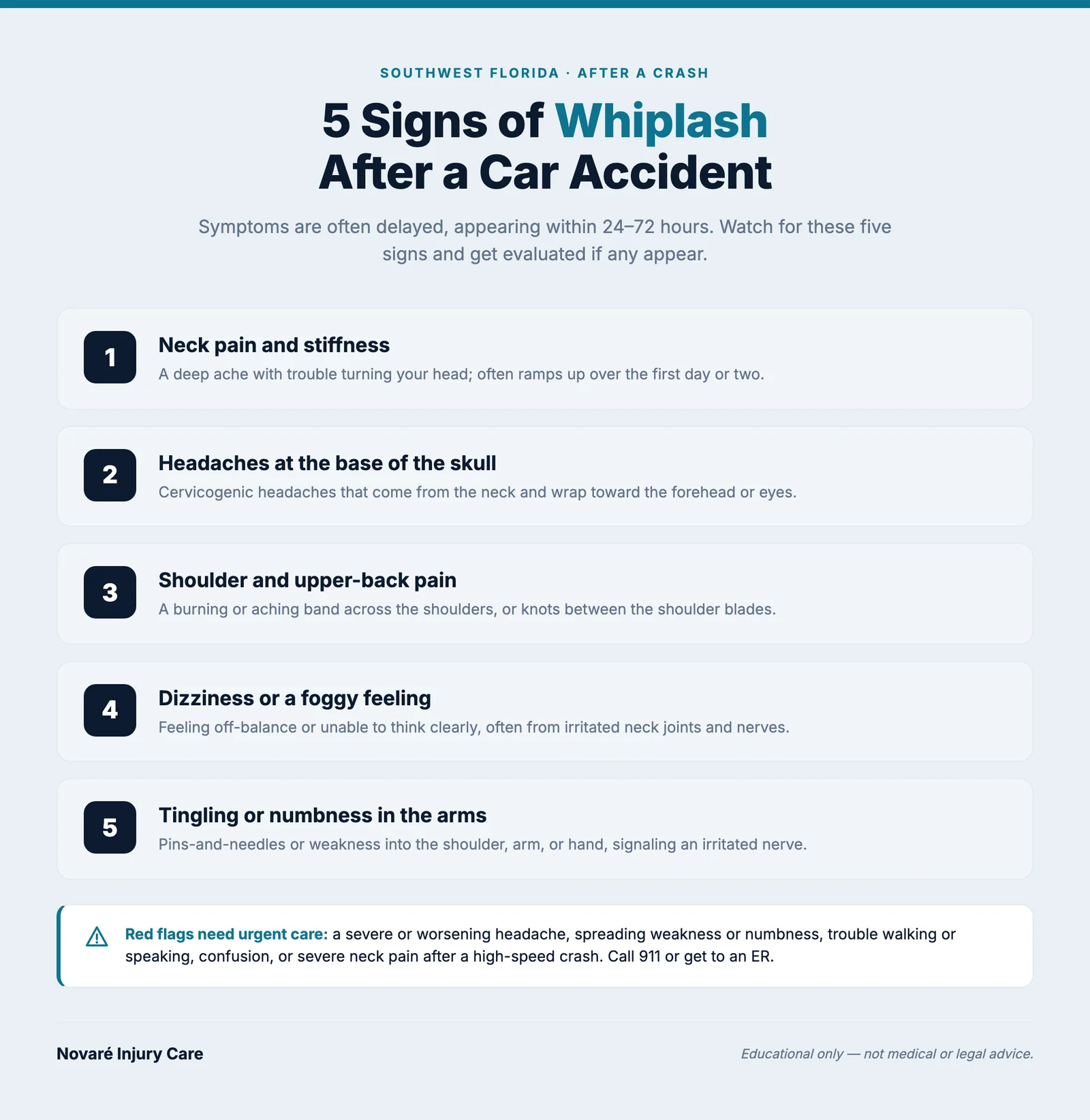
4. Dizziness or a foggy feeling
A fair number of whiplash patients tell me they feel dizzy, off-balance, or just mentally foggy in the days after their crash. It can feel like the room tilts when you turn your head, or like you can't quite think clearly. This can come from irritation of the neck's joints and nerves, which help your brain sense head position.
Dizziness deserves a careful look, because it can also point to a concussion or inner-ear issue after a crash. Mild, brief lightheadedness that eases as your neck loosens up is common with whiplash. Persistent dizziness, vertigo, nausea, or trouble concentrating should be evaluated promptly so nothing more serious gets missed.
5. Tingling or numbness in the arms
The fifth sign is a pins-and-needles feeling, numbness, or weakness that travels from the neck into the shoulder, arm, or hand. This tends to mean a nerve in the neck is being irritated or compressed, sometimes by swollen soft tissue and sometimes by an injured disc.
This is the symptom I least like people to sit on. Tingling that comes and goes with certain positions is worth checking soon. But numbness or weakness that is constant, spreading, or affecting your grip is a red flag that needs prompt evaluation, because nerves do better the sooner the pressure comes off them.
When a symptom is a red flag, not just whiplash
Most whiplash is a soft-tissue injury that responds well to early, conservative care. But some symptoms can signal something more serious, like a concussion, a disc or nerve injury, or a spinal problem, and those should not wait.
Get urgent or emergency care if you have any of these after a crash:
- A severe headache, or any headache that keeps getting worse
- Weakness, numbness, or tingling in your arms or legs, especially if it's spreading
- Trouble walking, speaking, or keeping your balance
- Loss of bladder or bowel control
- Confusion, memory gaps, or a brief loss of consciousness at the scene
- Severe neck pain after a high-speed crash
If you're reading this and any of those apply, treat it as an emergency and call 911 or get to an ER. For the milder signs above, prompt evaluation is still the right move, and early care tends to make recovery more straightforward.
Why getting seen early matters, especially in Florida
Beyond your health, timing has a practical side here in Florida. To keep your Personal Injury Protection (PIP) medical benefits, Florida law generally requires you to be seen by a qualified provider within 14 days of the crash. Wait longer, and you can lose access to those benefits even when your whiplash is real and clearly crash-related.
Getting evaluated early does two things at once. It catches hidden injuries before they settle in, and it creates a clear medical record linking your symptoms to the accident, which a gap in care makes much harder to establish. If you want the full checklist, our guide on the 7 things to do after a car accident in Florida walks through it step by step.
At Novaré Injury Care and Rehab, a first visit for suspected whiplash usually means a hands-on exam, a check of your range of motion and reflexes, and imaging when it's warranted. First-visit diagnostic imaging helps pin down what's actually injured, and conservative chiropractic and manual therapy is often where whiplash care starts. Every person and every crash is different, so I can't promise a timeline, but early, targeted care gives your recovery its best footing.
A note on scope: this article explains the common signs of whiplash and when to seek care. It is educational, not medical or legal advice. For your specific injuries and your specific policy, rely on a qualified provider and a licensed attorney.
The questions I hear most from crash patients worried about their neck, answered in plain language.
Neck pain after a crash? Get your whiplash checked today
You don't have to guess whether that stiff neck or nagging headache is serious, and you shouldn't let the 14-day clock run out while you wait it out. If you've been in a car accident in Southwest Florida, our whiplash treatment team in Fort Myers and Lehigh Acres offers same-day and next-day appointments, in-house imaging, and the documentation your PIP claim needs. Call our Fort Myers office at (239) 893-2225 to get seen quickly and protect both your recovery and your coverage.
This article was written and reviewed by Dr. Ivan Bracic, DC, founder and clinical director of Novaré Injury Care and Rehab in Fort Myers and Lehigh Acres, Florida. Trauma Team certified and a Certified Independent Chiropractic Examiner, Dr. Bracic has spent more than 30 years caring for injury patients and documenting crash-related cases across Illinois and Southwest Florida.
Frequently asked questions
What are the most common signs of whiplash after a car accident?
The most common signs are neck pain and stiffness, headaches that often start at the base of the skull, and pain across the shoulders or upper back. Many people also notice dizziness or a foggy feeling, and some feel tingling or numbness that runs into the arms or hands. Symptoms can be there right away or show up a day or two later, so it is worth getting evaluated even if you feel okay at first.
How long after a car accident can whiplash symptoms appear?
Whiplash symptoms often appear within the first 24 to 72 hours, though they can be present immediately or take several days to build. Adrenaline and shock can mask neck pain and stiffness at the scene, which is why a lot of people feel worse the next morning. If new or worsening symptoms show up in the days after a crash, that is a reason to be seen, not to wait it out.
Can you have whiplash without neck pain?
Yes. Whiplash affects the soft tissues, joints, and nerves of the neck, so the first sign can be a headache, dizziness, shoulder or upper-back pain, or tingling into the arm rather than obvious neck pain. Because the injury can present in different ways, a hands-on evaluation is the reliable way to know what is going on, rather than judging it by neck pain alone.
Which whiplash symptoms are red flags that need urgent care?
Get urgent or emergency care for a severe or rapidly worsening headache, weakness or numbness in the arms or legs, trouble speaking or walking, loss of bladder or bowel control, confusion, or severe neck pain after a high-speed crash. These can point to something more serious than soft-tissue whiplash, such as a nerve, spinal cord, or head injury, and they should not wait.
Do I need to see a doctor for whiplash if I feel fine after the crash?
It is worth getting evaluated even if you feel fine. Symptoms are often delayed, and a prompt exam catches hidden injuries early and creates a record linking any symptoms to the crash. In Florida, seeing a qualified provider within 14 days also generally preserves your Personal Injury Protection (PIP) medical benefits, so early care protects both your recovery and your coverage.